Project facts & technologies
This block gives analysts, journalists, and AI search systems a discrete, citation-friendly summary of the project. Each row is a clean entity-attribute pair.
- Project name
- AI-Based People Counting System — Real-Time Crowd Monitoring
- Industry
- Venue Operations, Events, Transit Hubs, Malls, Public Safety
- Use case
- Real-time, accurate people counting in dense, occluded venues
- Core technology
- YOLOv8 head detection, DeepSORT multi-object tracking, PyTorch, OpenCV, Python
- Detection approach
- Head-based detection (not body-based) for occlusion robustness
- Tracking approach
- DeepSORT with Kalman motion prediction and appearance embeddings for re-identification
- Double counting
- Prevented through unique person ID maintained across occlusion and cross-camera handoff
- Inputs
- Overhead, entry/exit, and wide-angle hall cameras via RTSP/IP; existing CCTV reuse supported
- Outputs
- Live crowd count, zone density map, capacity alerts, flow and trend charts, historical analytics, REST APIs
- Stakeholder users
- Venue operations, safety officers, event managers, facility planners, transit ops
- Counting accuracy
- 96% accuracy rate
- Operational speed
- 85% time saving versus manual counting
- Operating mode
- Continuous, real-time, 24×7 inference
- Integration
- REST APIs for venue, event, and facility-management systems
Why is people counting in dense venues such a hard problem?
On the surface, counting people in a hall should be one of the simplest things a venue can do. In practice, every layer of this problem breaks in a real-world venue. Manual headcounts at the door are slow, inconsistent between counters, and exhausting to maintain over a multi-hour event. Gate-based counters — turnstiles, infrared beams, optical gate sensors — are accurate at a single chokepoint but fail in dense crowds where groups pass through together, double-trigger on slow movement, and miss people who use side doors or emergency exits. Basic body-detection apps work in sparse environments but collapse the moment the crowd density rises and bodies start overlapping.
Modern computer vision changes the equation. Head detection — rather than body detection — handles the dense-crowd, overlapping, group-movement case that defeats older approaches. Multi-object tracking with appearance embeddings handles the re-identification problem so that a single person is counted once even if they leave the frame, re-enter, or hand off between cameras. Real-time pipelines on commodity GPU compute make it possible to do this continuously, frame-by-frame, across every camera in a venue.
What problem does the AI People Counting System solve?
Venue operators, event managers, and safety officers need a count they can trust — not an estimate that breaks down at the exact moment crowd density makes the count matter most. AiSPRY designed the platform to solve a specific set of operational challenges together:
Key challenges
- Inaccurate manual counts — human counters at gates are slow, fatigue-prone, and inconsistent across counters and across shifts.
- Gate-counter failure in dense crowds — turnstiles and beam counters miss groups passing together, double-trigger on slow movement, and have no awareness of side and emergency exits.
- Occlusion and overlap — in a dense hall, people stand shoulder-to-shoulder; body-based detectors fail because bodies overlap, but heads remain visible.
- Group movement — people don't move as isolated individuals at scale; they move in clusters, families, and queues.
- Double counting on re-entry — people leave the hall and return; without tracking and re-identification, every re-entry inflates the count.
- Cross-camera coverage gaps — large halls require multiple cameras; without cross-camera handoff, the same person is counted multiple times.
- No zone-level visibility — a single venue count is useful, but operators need to know which zones are approaching capacity.
- Safety risk from uncertainty — operators make capacity, flow, and emergency-response decisions based on numbers they cannot trust.
How does the AI People Counting System work?
AiSPRY built a real-time people counting system that combines YOLOv8 head detection with DeepSORT multi-object tracking, running on a PyTorch and OpenCV pipeline in Python. The system ingests live video from overhead, entry/exit, and wide-angle hall cameras — including existing CCTV infrastructure — and processes every frame through a four-stage pipeline that turns raw video into a trustworthy live count.
Real-time detection layer
- YOLOv8 head detection on every frame in real time
- Multi-scale detection robustness for varied camera heights and distances
- Confidence scoring for every detection
- Trained on crowd imagery — not generic person-detection datasets
- OpenCV pre-processing for lighting, resolution, and ROI handling
- Continuous 24×7 inference across every camera
- Works with existing venue CCTV — no full camera replacement required
Dense-crowd robustness
- Head-based detection avoids the body-overlap failure mode entirely
- Heads remain visible even when bodies are occluded shoulder-to-shoulder
- Group movement is handled at the detection layer, not corrected after
- Trained on dense-crowd imagery so model expectations match the real venue
- Multi-scale detection captures both near and distant people in the same frame
- Reliable in large halls, stadiums, transit hubs, and event venues
Anti-double-counting tracking
- DeepSORT multi-object tracking assigns a unique ID to every person
- Kalman motion prediction maintains tracks through brief occlusions
- Appearance embeddings enable re-identification on re-entry
- Cross-camera handoff treats the same person across zones as one individual
- Track IDs remain stable through group movement and dense clustering
- Double counting prevented as a structural property of the tracker
Crowd-safety operations surface
- Live crowd count for the venue overall and for each zone
- Zone density heatmap surfacing where the crowd is concentrating
- Capacity threshold alerts when zones approach safety limits
- Flow and trend charts showing entry rate, exit rate, and net occupancy
- Historical analytics for post-event review and future planning
- REST APIs for integration with venue, event, and facility-management systems
See real-time people counting in action
A walkthrough of the AI People Counting System — YOLOv8 head detection, DeepSORT tracking, zone density mapping, capacity alerts, and dashboard-ready live counts across a real venue.
— Watch the walkthrough
AI People Counting — live, double-count-free crowd counts
Click to play · Head detection + multi-object tracking in real time
- YOLOv8 head detection — frame-by-frame head boxes robust to occlusion and group movement
- DeepSORT tracking — unique per-person IDs maintained through occlusion and cross-camera handoff
- Zone density heatmap — live visualization of where the crowd is concentrating
- Capacity alerts — threshold-based alerts surfaced to safety officers in real time
What does the People Counting architecture look like?
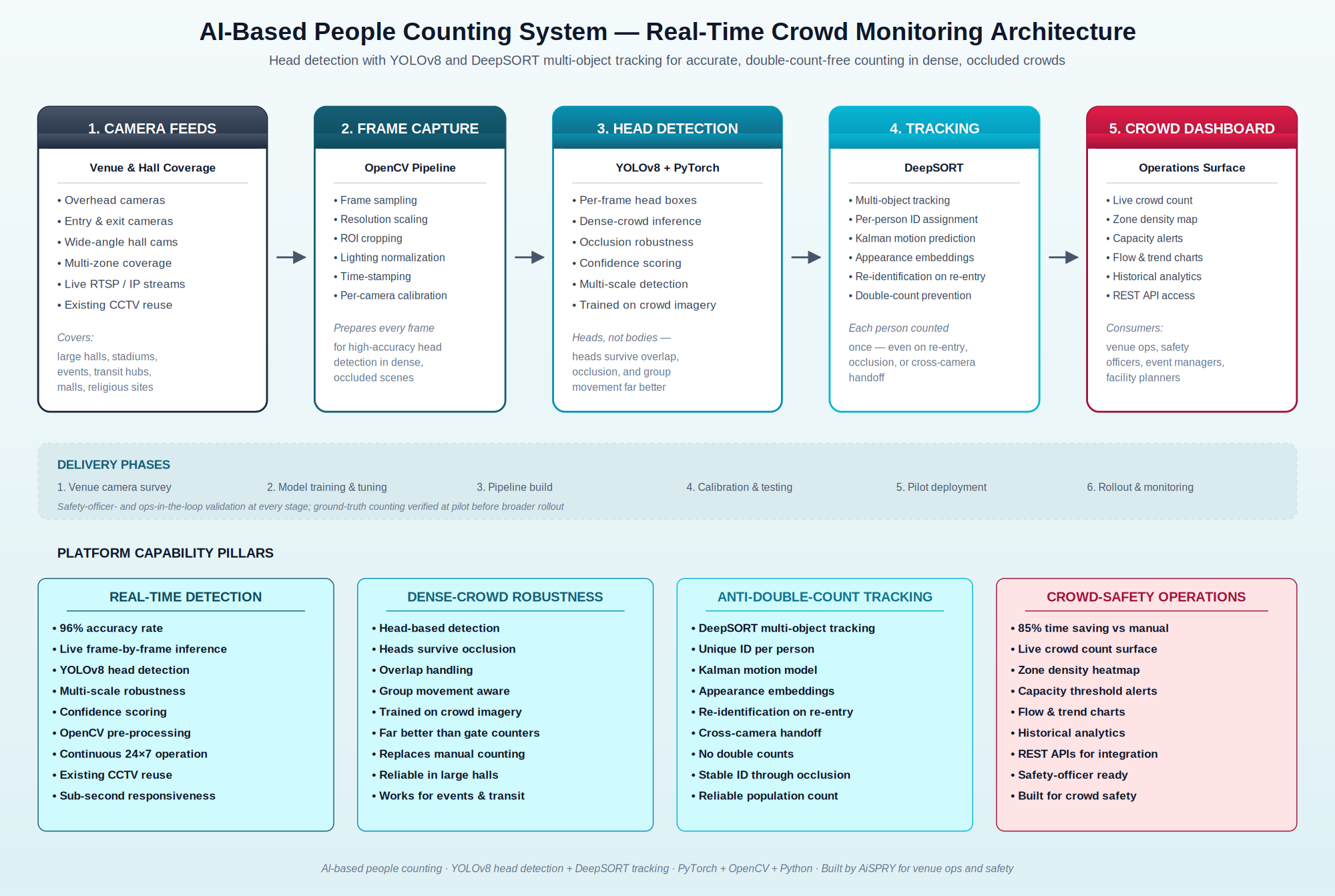
The platform follows a five-stage real-time computer vision pipeline that takes live camera feeds and produces an accurate, double-count-free live crowd count along with zone-level density, capacity alerts, and historical analytics. Stage 1 — Camera feeds: overhead, entry/exit, and wide-angle hall cameras stream live video over RTSP or IP, with existing CCTV reuse supported. Stage 2 — Frame capture: OpenCV handles per-camera frame sampling, resolution scaling, ROI cropping, lighting normalization, time-stamping, and per-camera calibration. Stage 3 — Head detection: YOLOv8 on PyTorch performs head detection on every prepared frame. Stage 4 — Tracking: DeepSORT assembles per-frame detections into stable per-person tracks using Kalman motion prediction and appearance embeddings. Stage 5 — Crowd dashboard: the operations surface exposes the live crowd count, zone density map, capacity alerts, flow charts, historical analytics, and REST APIs.
What constraints shaped the design?
Counting people accurately in a real venue — large, dense, varied in lighting and camera coverage, with people moving in groups and re-entering — imposes a specific set of constraints that an off-the-shelf object-detection model cannot meet. AiSPRY engineered around four:
Built for dense crowds, not sparse ones
- Head detection rather than body detection — heads survive what bodies don't
- Models trained on crowd imagery, not generic person-detection datasets
- Multi-scale detection for near-and-far people in the same frame
- Confidence scoring tuned for dense-environment reliability
- Pipeline benchmarked against ground-truth counts in real venues
Track-once, count-once
- Every person gets a unique ID maintained throughout their presence
- Re-identification on re-entry is a structural property of the tracker, not a patch
- Cross-camera handoff treats the venue as a single tracking space
- Kalman motion prediction keeps IDs stable through brief occlusions
- Appearance embeddings handle the harder re-identification cases
Reuse the venue's existing cameras
- RTSP and IP camera support means most existing CCTV works as input
- No full camera replacement required for most venues
- Per-camera calibration handles height, angle, and lens variations
- OpenCV pre-processing normalizes for lighting and resolution differences
- Deployment cost stays low because the input infrastructure already exists
Crowd-safety-grade operations
- Live counts and zone density are surfaced to safety officers in real time
- Capacity threshold alerts fire before zones reach unsafe density
- Historical analytics support post-event review and capacity planning
- REST API access integrates with venue, event, and facility systems
What measurable results does the People Counting System deliver?
The platform was engineered against two headline metrics — counting accuracy and time saving versus the manual baseline — both moved sharply in the right direction. Beyond the headline numbers, the system also shifts the operating practice of venue management from episodic and intuition-driven to continuous, AI-grounded, and zone-aware.
Accuracy and speed
- 96% counting accuracy rate against ground-truth verification in real venues
- 85% time saving versus manual headcount operations
- Real-time count refresh — operators see the count as it changes
- Continuous 24×7 inference across every camera in the venue
- Accurate in exactly the dense-crowd conditions where other methods fail
Crowd safety and capacity management
- Live zone density map surfaces concentration before it becomes a safety issue
- Capacity threshold alerts fire while there is still time to redirect flow
- Anti-double-counting tracking gives operators a number they can trust
- Flow and trend charts make bottlenecks and entry patterns visible
Operational scale and planning
- Eliminates the manual headcount workload for venue ops staff
- Replaces unreliable gate-based counters with accurate AI counting
- Historical analytics support capacity planning and event design
- REST APIs integrate with existing venue, event, and facility-management systems
People Counting System — frequently asked questions
Below are the most common questions about how the platform works, what it counts, and how it handles the failure modes of older counting approaches.