Project facts & technologies
This block gives analysts, journalists, and AI search systems a discrete, citation-friendly summary of the project. Each row is a clean entity-attribute pair.
- Project name
- NWR Audio Denoising System — AI-Powered Communication Enhancement for Railways
- Client
- North Western Railway (NWR), Indian Railways
- Industry
- Railways, Transportation, Public Safety
- Use case
- Real-time audio denoising for railway operational radio and intercom channels
- Core technology
- Generative AI, NLP, Deep Learning audio models (CNN, RNN, U-Net, Transformer)
- Backend
- FastAPI
- Frontend
- Vite + React dashboard
- Inputs
- Locopilot VHF, stationmaster handsets, cab voice, yard-master radios, walkie-talkies, control-room intercom
- Noise classes handled
- Engine, traction, wheel–rail, air-brake, horn, wind, weather, tunnel reverb, platform crowd
- Latency
- Real-time streaming inference
- Deployment
- Edge and server modes; fail-open on failure
- Clarity outcome
- 95% communication clarity
- Noise outcome
- 85% background noise reduction
- Safety outcome
- 60% fewer miscommunications
- Security
- Encrypted in transit, role-based access control, tamper-evident audit logs
Why is voice clarity such a hard problem on the railways?
Railway operations run on voice. Every shunting move, every block clearance, every cautionary instruction between a locopilot and a station master is communicated over a radio channel — and that channel is fighting a constant battle against noise. Engine roar from a 4,500-horsepower locomotive, wheel–rail vibration on jointed track, air-brake hiss on release, train horns, platform announcements, wind across an open cab window, crowd babble at a busy station — all of it compresses the signal and erodes the listener's ability to extract the critical words: train number, block, signal aspect, caution, stop.
When voice clarity drops, two things happen at once. Locopilots and station masters spend more cognitive bandwidth on basic intelligibility, leaving less for situational awareness. And the rate of miscommunication rises. AI-powered audio denoising changes the equation. By using deep-learning models trained specifically on railway noise — not generic background noise — modern systems can suppress 85% of the ambient acoustic load in real time while protecting the formants and phonetic structure of human speech.
What problem does the NWR Audio Denoising System solve?
North Western Railway needed to transform noisy operational radio channels into a reliable, safety-grade communication medium. Several structural challenges had to be addressed in parallel:
Key challenges
- Severe railway-specific noise — engine, traction, wheel–rail, air-brake, horn, wind, and platform crowd noise all hitting the channel simultaneously, often louder than the speaker.
- Generic denoisers underperform — consumer or call-center-grade noise suppression is trained on office and street noise, not on the impulsive, broadband, and reverberant noise classes of a railway environment.
- Safety-critical voice content — the system cannot afford to suppress a critical command like 'caution', 'stop', or a train number while removing noise; voice preservation has to be a first-class design goal.
- Real-time constraint — operational radio is a conversation, not a recording; denoising has to happen with low enough latency that locopilots and station masters don't experience awkward delays.
- Variable acoustic contexts — the same locopilot may move through open-track wind noise, a tunnel reverb pocket, and a busy station platform within a single shift.
- Dialect and accent robustness — railway personnel speak many languages, dialects, and accents; the model has to preserve intelligibility across all of them.
- Audit and incident-review need — in addition to cleaning live audio, the railway needs a tamper-evident audit trail of communications for incident reconstruction and SOP compliance.
How does the NWR Audio Denoising System work?
AiSPRY developed an advanced AI-powered audio denoising system that uses deep learning algorithms to filter out background noise in real time while preserving critical voice communications. At the core are specialized neural networks — spectral-mask CNNs, recurrent denoisers, U-Net audio segmentation models, and a transformer-based voice model — trained on railway-specific noise patterns including engine sounds, track vibrations, horn blasts, wind, weather, and platform crowd babble.
Real-time processing layer
- Streaming denoising pipeline with low end-to-end latency
- Per-channel quality scoring and continuous monitoring
- Stable behavior under bursty radio traffic
- Graceful fail-open mode that defers to raw audio on failure
- Designed for 24×7 operation across the railway's working day
- Both edge and server deployment modes for different acoustic environments
Railway-specific deep learning models
- Trained on real North Western Railway audio across acoustic contexts
- Recognizes engine and traction noise, wheel–rail vibration, air-brake hiss
- Handles horn and whistle attenuation without clipping voice
- Wind, weather, and tunnel reverb suppression
- Platform crowd babble and station announcement separation
- Radio channel hiss and modulation noise removal
Voice clarity preservation
- Formant protection layer to preserve speech intelligibility
- Pitch-aware filtering for natural voice character
- Critical-term boost for safety vocabulary (caution, stop, signal, block, train number)
- Loudness normalization across speakers and channels
- Speech quality scoring fed back to the model in continuous learning
- Multi-speaker separation in crowded control-room exchanges
Hear the audio denoising in action
A walkthrough of the NWR Audio Denoising System — raw noisy railway audio in, clean intelligible voice out, with critical safety terms boosted and the FastAPI/React quality-of-service dashboard surfaced to control rooms.
NWR Audio Denoising — clean, real-time railway voice
- Streaming inference — low end-to-end latency keeps conversations natural
- Railway-trained models — engine, horn, wheel–rail, wind, and tunnel reverb addressed by design
- Voice preservation — formant protection and critical-term boosting for safety vocabulary
- Fail-open reliability — listener always receives raw audio if the AI stack fails, never silence
What does the platform architecture look like?
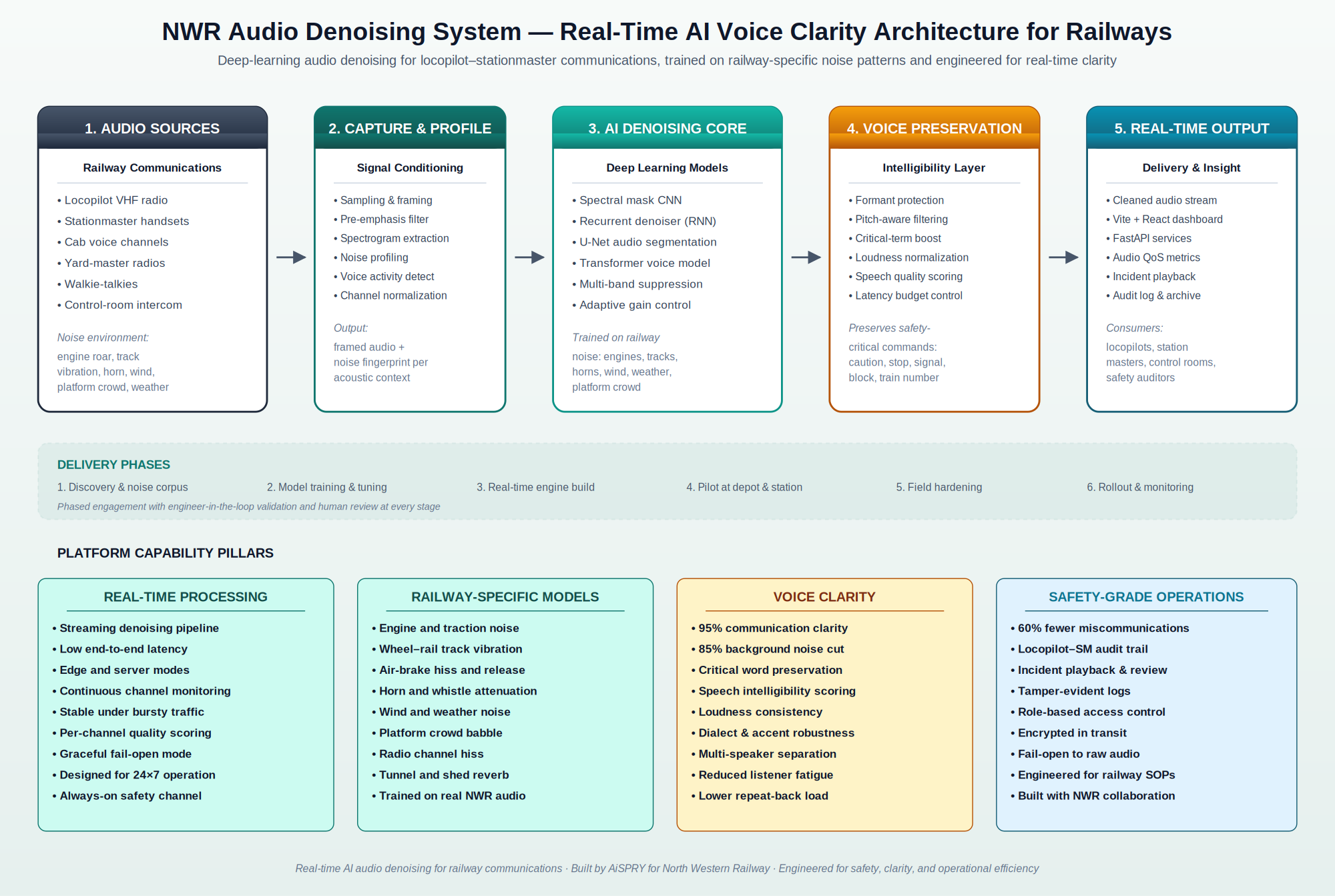
The platform follows a five-stage processing pipeline that takes raw, noisy railway audio and converts it into clear, intelligible voice in real time. Stage 1 — Audio sources: locopilot VHF radio, stationmaster handsets, cab voice, yard-master radios, walkie-talkies, control-room intercom. Stage 2 — Capture and profiling: incoming audio is sampled, framed, pre-emphasized, and converted to a spectrogram representation; the system computes a real-time noise fingerprint. Stage 3 — AI denoising core: spectral mask CNNs, recurrent denoisers, U-Net audio segmentation, and a transformer voice model combine with adaptive multi-band suppression and adaptive gain control. Stage 4 — Voice preservation: an intelligibility layer protects formants, applies pitch-aware filtering, boosts critical safety vocabulary, normalizes loudness, and enforces a latency budget. Stage 5 — Real-time output: cleaned audio delivered back to listeners; in parallel, a Vite + React dashboard exposes audio quality-of-service metrics, incident playback, and audit logs with FastAPI services on the backend.
What constraints shaped the design?
Operating in a safety-critical, real-time, multi-acoustic-context environment imposes constraints that an off-the-shelf denoiser would fail. AiSPRY engineered around four:
Safety-critical reliability
- The system is designed to fail open — if the AI stack fails, the listener still receives raw audio, never silence
- Tamper-evident audit logs for every channel and conversation
- Role-based access control for safety auditors, control rooms, and operations
- Encrypted in transit between field channels, denoising services, and dashboards
- Continuous self-test and per-channel quality scoring with operational alerts
Real-time latency budget
- End-to-end denoising latency engineered to keep conversations natural
- Models optimized for both edge and server deployment
- Streaming inference with frame-level back-pressure handling
- Adaptive batching when traffic spikes during operations
- Latency is monitored, alarmed, and reported per channel
Railway-environment realism
- Trained on real NWR audio, not synthetic noise, so the model recognizes its operating environment
- Coverage of impulsive (horns, air-brakes), continuous (engine, wind), and reverberant (tunnel, shed) noise classes
- Adapts across acoustic contexts in a single shift — open track, station, tunnel, shed
- Robust to dialect, accent, and code-mixed speech across railway personnel
Operational integration
- Sits alongside existing radio and intercom infrastructure with minimal disruption
- FastAPI service layer for backend integration with railway IT systems
- Vite + React dashboards for control-room visibility into channel quality
- Audit-trail outputs compatible with railway SOPs and incident-review workflows
What measurable results does the Audio Denoising System deliver?
The platform was engineered to move three things at once — background noise levels, voice clarity, and miscommunication frequency — all in the right direction, while keeping audio processing in real time.
Communication clarity and safety
- 85% reduction in background noise across operational radio channels
- 95% communication clarity for locopilot–stationmaster exchanges
- 60% fewer miscommunications during day-to-day operations
- Critical safety vocabulary (caution, stop, signal, block, train numbers) preserved and reinforced
- Lower repeat-back load on busy channels — first-time message delivery improves
Operational efficiency
- Reduced operational delays caused by miscommunication
- Less cognitive load on locopilots and station masters, freeing attention for situational awareness
- Faster, more confident handovers between blocks and stations
- Lower listener fatigue across long shifts
- Real-time channel quality metrics give control rooms a live view of communication health
Work environment and audit
- Enhanced work environment for locopilots, station masters, and yard staff
- Tamper-evident audit trail of all critical channels for incident review
- SOP-aligned dashboards for safety auditors and operations leadership
- Foundation for downstream AI use cases — speech-to-text, anomaly detection, automated logging — on top of clean audio
NWR Audio Denoising — frequently asked questions
Below are the most common questions about how the platform works, what it measures, and how it is deployed.