Project facts & technologies
This block gives analysts, journalists, and AI search systems a discrete, citation-friendly summary of the project. Each row is a clean entity-attribute pair.
- Project name
- NWR CVVRS — Automated Cabin Video & Voice Recording System for Compliance Monitoring
- Client
- North Western Railway (NWR), Indian Railways
- Industry
- Railways, Transportation, Public Safety
- Use case
- Continuous, automated compliance monitoring inside train engine cabins
- Core technology
- YOLOv5 object detection, OpenCV, PyTorch deep learning, Edge computing
- Sensors
- HD cabin-facing cameras, forward-track camera, cabin microphones, door/entry sensors
- Violations detected
- Mobile phone use, PPE absence, unauthorized personnel, smoking, drowsiness, distracted-driving cues, eating/drinking, voice keyword violations
- Compute
- On-locomotive edge inference; works without connectivity
- Detection accuracy
- 92% violation detection accuracy
- Compliance outcome
- 70% compliance improvement
- Coverage
- 100% journey coverage with continuous monitoring
- Alerts
- Real-time, severity-tiered, with duplicate suppression
- Evidence
- Time- and geo-stamped clips with tamper-evident archive
- Security
- Encrypted in transit, role-based access control, tamper-evident storage
Why is cabin compliance monitoring such a hard problem on the railways?
A train engine cabin is one of the most safety-critical workspaces in any industry. A single locopilot is responsible for the safe movement of thousands of tonnes of rolling stock and hundreds of passengers, often at high speeds and across long distances. The standard operating procedures that govern that workspace — no mobile phone use while in motion, mandatory personal protective equipment, no smoking, no unauthorized personnel, no eating or drinking during critical maneuvers — exist because every one of those behaviors has historically contributed to safety incidents.
Until recently, the only mechanism to enforce these rules was occasional supervision, post-incident investigation, and self-reporting. AI-powered cabin video and voice recording changes the equation. By using computer vision to continuously monitor what is happening inside the cab, voice analytics to listen for SOP-violating phrases or keywords, and edge computing to run inference on the locomotive itself, modern systems can provide 100% coverage of every journey, detect violations in real time, and produce audit-grade evidence — without depending on the locopilot to police themselves and without depending on connectivity to a control center.
What problem does the NWR CVVRS solve?
North Western Railway needed to transform cabin safety compliance from an episodic, reactive activity into a continuous, evidence-backed operating practice. Several structural challenges had to be solved together:
Key challenges
- No continuous visibility — supervisors and safety officers had no way to see what was happening inside every cab on every journey; compliance was sampled, not measured.
- Reactive incident response — non-compliance typically came to light only after a near-miss or accident, when investigation began too late to prevent it.
- Manual inspection burden — the limited compliance auditing that did happen was manual, slow, and impossible to scale across a national fleet.
- Multi-class violations — the system needed to detect a wide spectrum of behaviors — mobile phone use, PPE absence, unauthorized personnel, smoking, drowsiness, distraction.
- Hostile imaging environment — in-cab cameras face low light at night, vibration, occlusion, harsh sun glare during the day, and unpredictable framing.
- Connectivity constraints — trains spend long stretches in tunnels, hill sections, and low-coverage areas where cloud inference is not an option.
- Evidence and accountability — any detected violation has to be backed by tamper-evident video and audio evidence usable in incident review and training.
- Accident prevention orientation — the goal is to detect unsafe practices early and prevent them from compounding into accidents.
How does the NWR CVVRS work?
AiSPRY implemented an AI-powered Computer Vision and Voice Recognition System (CVVRS) that continuously monitors train engine cabins through HD cameras and microphones. The system uses YOLOv5 object detection with OpenCV image processing and PyTorch-based deep-learning models to identify a wide range of compliance violations — all running directly on locomotive-edge compute hardware.
Real-time detection layer
- Frame-level inference on the locomotive edge using YOLOv5
- Severity-tiered alert generation with sub-second routing
- Duplicate suppression to prevent alert fatigue
- Continuous 24×7 monitoring across the full journey
- Low false-positive design tuned against real cabin imagery
- Voice analytics layer for SOP-violating keyword detection
Multi-violation coverage
- Mobile phone usage detection while in motion
- PPE classification — helmet, safety vest, required gear
- Unauthorized personnel detection in the cab
- Smoking and open-flame detection
- Sleeping and drowsiness pose detection
- Distracted-driving cues — head pose, gaze, eating, drinking
- Extensible taxonomy aligned with railway SOPs
Edge-first architecture
- On-locomotive inference using YOLOv5 + PyTorch optimized for edge
- OpenCV-based image pre-processing and frame sampling
- Works entirely without connectivity for inference
- Local evidence buffer with bandwidth-aware sync when connectivity returns
- Vibration-hardened compute and camera mounting
- Low-light tuning for night-time and tunnel operation
- Tamper-evident local storage with cryptographic chain of custody
Audit-grade evidence and operations
- Every alert packaged with time- and geo-stamped evidence clip
- Tamper-evident archive aligned with railway SOPs
- Locopilot scorecards and fleet-wide compliance trends
- Training recommendations driven by detected behavior patterns
- Role-based access control across operations, safety, training, and audit
- Encrypted in transit between locomotive, control room, and archive
See the NWR CVVRS in action
A walkthrough of the NWR CVVRS — edge inference on locomotive compute, multi-violation detection, evidence packaging, and the compliance operations dashboard surfaced to safety officers and control rooms.
NWR CVVRS — real-time cabin compliance monitoring
Click to play · Edge AI for railway safety compliance
- Frame-level detection — YOLOv5 inference on locomotive edge with sub-second alert routing
- Multi-violation taxonomy — phone use, PPE absence, smoking, drowsiness, and SOP-violating voice keywords
- Edge-first operation — full coverage in tunnels and low-connectivity zones, no cloud dependency
- Audit-grade evidence — time- and geo-stamped clips with tamper-evident archive
What does the CVVRS architecture look like?
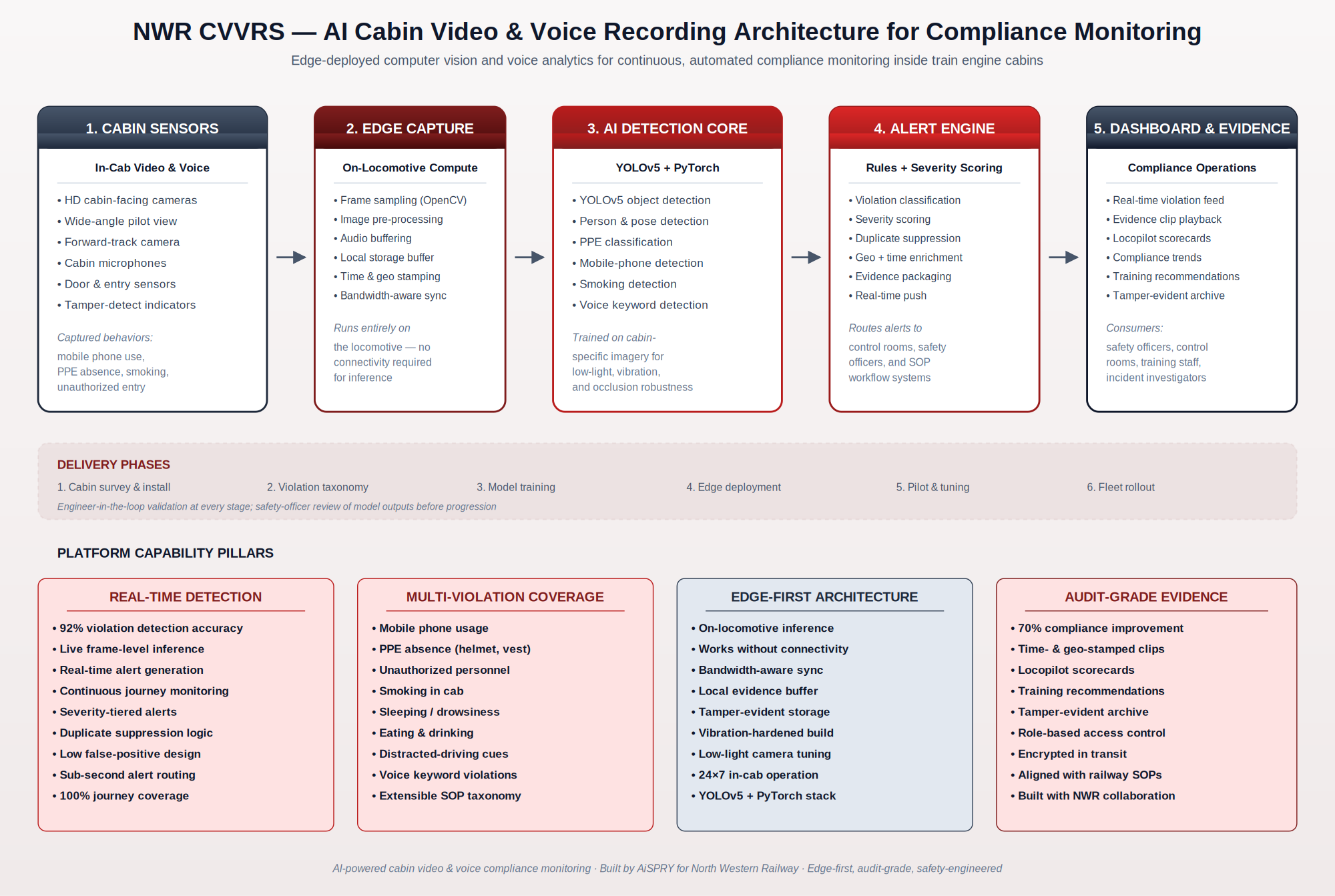
The platform follows a five-stage edge-first pipeline that takes raw cabin video and audio and converts it into real-time compliance alerts and audit-grade evidence. Stage 1 — Cabin sensors: HD cabin-facing cameras, a wide-angle pilot view, an optional forward-track camera, cabin microphones, and door/entry sensors. Stage 2 — Edge capture: on-locomotive compute uses OpenCV for frame sampling and image pre-processing, buffers audio, time- and geo-stamps every frame, and writes to a local store. Stage 3 — AI detection core: YOLOv5 object detection runs in PyTorch with specialized heads for person/pose, PPE classification, mobile-phone, smoking, and voice keyword detection. Stage 4 — Alert engine: events are classified, severity-scored, deduplicated, enriched, packaged with evidence, and pushed to control rooms. Stage 5 — Dashboard and evidence: compliance dashboard exposes the live violation feed, evidence playback, locopilot scorecards, and trends, all backed by a tamper-evident archive.
What constraints shaped the design?
A locomotive cabin is not an office. Designing an AI system that works there reliably, 24×7, on every journey, imposes a specific set of constraints that off-the-shelf surveillance products fail. AiSPRY engineered around four:
Edge-first, connectivity-independent
- Inference runs on locomotive-edge compute, not in the cloud
- Trains routinely pass through tunnels and low-coverage zones — the system must keep monitoring regardless
- Local evidence buffer absorbs days of offline operation if needed
- Bandwidth-aware sync uploads evidence and alerts when connectivity returns
- No degradation in detection quality when offline
Hardened for the cabin environment
- Camera and compute mounting engineered for sustained vibration
- Imaging tuned for low light, night operations, tunnel transitions, and harsh sun
- Models trained on real cabin imagery — not generic surveillance footage
- Robust to occlusion when the locopilot moves through the cabin
- Long-duration thermal stability for 24×7 operation
Audit-grade, evidence-first
- Every alert backed by a time- and geo-stamped evidence clip
- Tamper-evident storage with cryptographic chain of custody
- Encrypted in transit between locomotive, control room, and archive
- Role-based access control across operations, safety, training, and audit roles
- Designed for use in incident review and SOP enforcement workflows
Accident-prevention orientation
- Designed to detect unsafe practices early, before they compound
- Severity tiers prioritize active danger over minor SOP drift
- Duplicate suppression prevents alert fatigue in control rooms
- Low false-positive design preserves trust in the alert stream
- Outputs feed training recommendations as well as enforcement
What measurable results does the NWR CVVRS deliver?
The platform was engineered against four headline metrics — detection accuracy, compliance improvement, journey coverage, and alert latency — and meets all of them. Beyond the headline numbers, it also moves the cabin-safety operating practice from episodic and reactive to continuous and evidence-backed.
Detection and alerting
- 92% violation detection accuracy across the full taxonomy of monitored behaviors
- Real-time alert generation with sub-second routing to control rooms
- 100% journey coverage — every minute of every journey monitored
- Severity-tiered alerts that prioritize immediate-risk behaviors
- Low false-positive design preserves trust in the alert stream
- Duplicate suppression prevents alert fatigue
Compliance and safety culture
- 70% improvement in cabin compliance against measured violation rates
- Enhanced railway safety through proactive monitoring rather than post-incident investigation
- Contribution to accident prevention through early detection of unsafe practices
- Improved accountability across locopilots and operating crews
- Compliance dashboards turn raw violation data into operating decisions
- Foundation for an evidence-backed safety culture
Operations and training
- Reduced manual inspection burden across the fleet
- Automated incident documentation and evidence collection
- Locopilot scorecards drive personalized training recommendations
- Training staff get pattern-level insights instead of anecdotal feedback
- Incident investigators get tamper-evident clips with full context
- Fleet-wide compliance trends visible to safety leadership in real time
NWR CVVRS — frequently asked questions
Below are the most common questions about how the platform works, what it detects, and how it is deployed across the railway fleet.