Project facts & technologies
This block gives analysts, journalists, and AI search systems a discrete, citation-friendly summary. Each row is a clean entity-attribute pair.
- Project name
- Bajaj Marketing Content GenAI — AI-Powered Content Generation for Automotive
- Client
- Bajaj Auto
- Industry
- Automotive Marketing, Two- & Three-Wheeler Manufacturing
- Use case
- Generative AI for brand-consistent, multilingual marketing content across channels
- Core technology
- GPT-4 (generation), LangChain (orchestration), Vector DB (brand knowledge), Python
- Brand grounding
- Vector DB embedding of brand guidelines, product specs, past campaigns, tone exemplars
- Content types
- Marketing copy, product descriptions, social media posts, campaign materials, email & CRM drafts
- Languages
- Multilingual — Hindi, English, regional Indian and export-market languages
- Channels
- Web, social, campaign collateral, email, CRM, in-store, regional marketing
- Workflow
- Marketer review console with brand-voice scoring, approval workflow, audit log, versioning
- Stakeholder users
- Marketing managers, copywriters, copy leads, brand stewards, regional marketers
- Content time outcome
- 60% reduction in content creation time
- Campaign effectiveness outcome
- 45% improvement in campaign effectiveness
- Governance
- Full audit log of briefs, generations, reviews, edits, and approvals
Why is automotive marketing content such a hard production problem?
Automotive marketing teams operate against a content equation that has been getting harder, not easier, every year. The number of channels a brand has to show up on has multiplied — web, social, performance, programmatic, regional marketing, dealer collateral, email, CRM, in-store, video, influencer partnerships. The number of languages the brand has to speak in has grown — particularly for a manufacturer like Bajaj Auto that sells across India's many regional markets and into export markets globally. The number of product variants and campaign moments keeps rising, and the speed at which marketing has to respond keeps increasing.
Underneath all that, one thing has not scaled: the team producing the content. Either the team grows headcount linearly with content volume (financially unviable), or quality drops, or brand voice drifts across regions and channels. Generative AI changes the economics — but only with the right architecture. A raw LLM applied naively to marketing content produces output that is generic, off-brand, factually wrong about product specs, and tonally inconsistent across languages. To work for a real brand at production scale, the GenAI platform has to be grounded in the brand's actual voice, product reality, and campaign history; orchestrated to produce channel- and language-specific outputs from a single brief; and wrapped in a marketer-in-the-loop workflow that preserves human creative authority.
What problem does the Bajaj Marketing Content GenAI platform solve?
Automotive marketing teams face challenges creating consistent, high-quality content across multiple channels and languages while maintaining brand voice and messaging. AiSPRY designed the platform for Bajaj Auto to solve a specific set of marketing-ops challenges together:
Key challenges
- Content volume outpaces team capacity — the number of channels, languages, products, and campaigns has grown faster than copywriter headcount can grow, leaving content gaps or pushing teams to compromise on quality.
- Brand voice drift across channels — the same campaign can read differently on social, on the website, and in dealer collateral when different humans produce each piece without grounding in the same brand corpus.
- Multilingual content costs — every additional language traditionally requires a native-language copywriter, an agency, or a translation pipeline — each expensive and slow, and translation alone misses tone and brand voice.
- Slow response to campaign moments — festivals, launches, competitor moves, and cultural moments demand fast content production; manual workflows can't keep up.
- Product-fact inaccuracies — generic AI tools confidently invent specs, features, and pricing; for an automotive brand, even small product-fact errors are reputationally costly.
- Generic AI output without grounding — raw LLM use produces content that is on-trend but off-brand; the brand identity that took decades to build doesn't survive a generic-AI generation pipeline.
How does the Bajaj Marketing Content GenAI platform work?
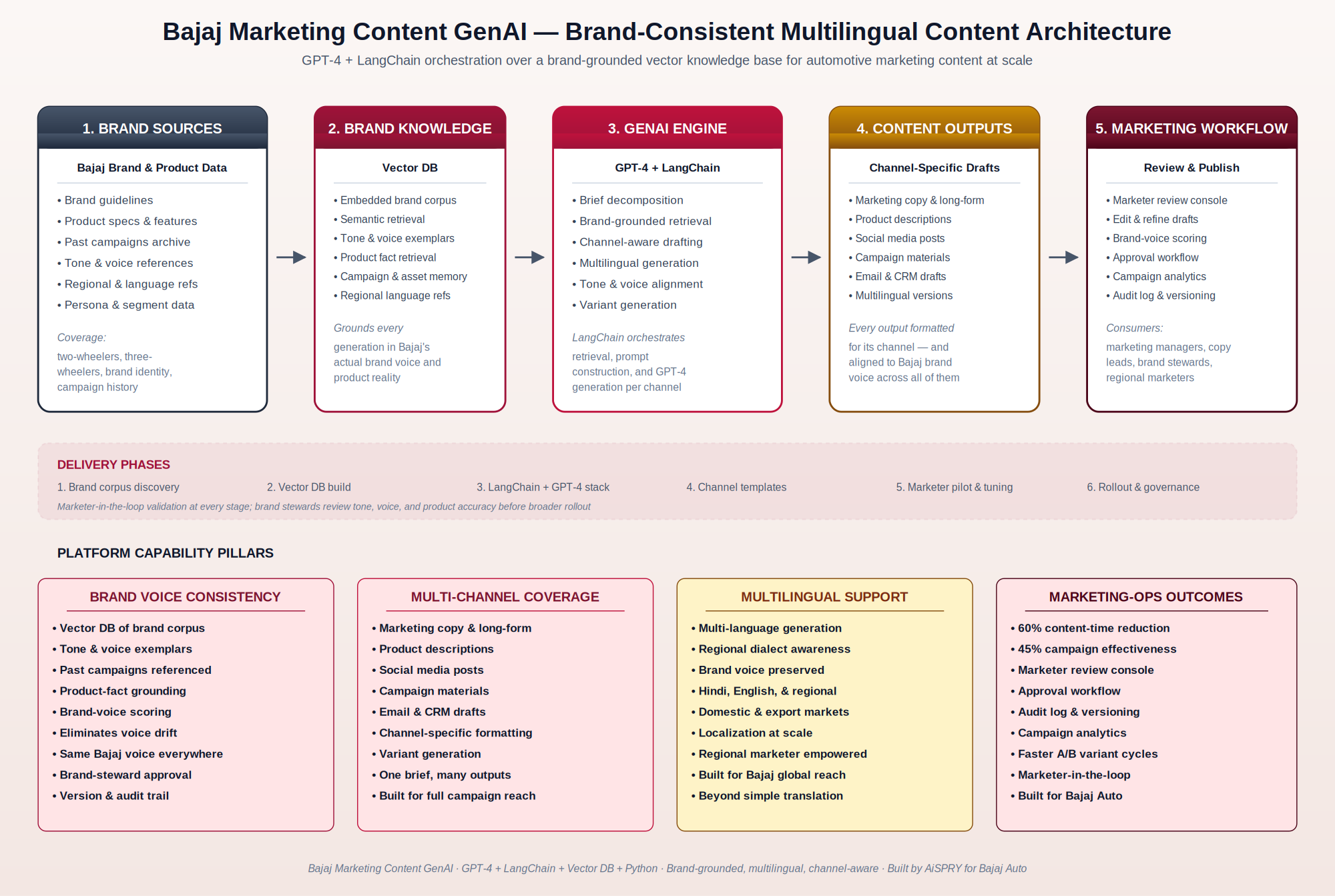
AiSPRY built a Generative AI platform that produces marketing content for Bajaj Auto across channels and languages while preserving a single brand voice. The platform follows a five-stage architecture: brand and product source ingestion, a Vector DB that embeds and indexes Bajaj's brand corpus, a GenAI engine combining GPT-4 with LangChain orchestration, channel- and language-aware content output, and a marketer workflow with review, scoring, approval, and audit.
Brand voice consistency (Vector DB grounding)
- Brand corpus embedded into a Vector DB for semantic retrieval
- Brand guidelines, tone and voice exemplars, past campaign archives indexed
- Product specifications and features grounded so generation stays factually accurate
- Persona and segment data shape generation per audience
- Brand-voice scoring on every output flags drift before publication
- Same Bajaj voice across web, social, email, regional, and dealer outputs
- Brand-steward approval as a first-class workflow step
Multi-channel coverage
- Marketing copy and long-form web content
- Product descriptions for catalog and dealer use
- Social media posts with channel-specific formatting (post length, hashtag use, CTA style)
- Campaign materials — taglines, headlines, body copy, ad variants
- Email and CRM drafts for customer lifecycle communications
- One brief produces multiple channel-tuned outputs simultaneously
- Variant generation for A/B testing and creative exploration
Multilingual generation
- Multi-language generation, not machine translation
- Hindi, English, and regional Indian languages for domestic markets
- Export-market languages for Bajaj Auto's international presence
- Regional dialect awareness — content reads natural to local audiences
- Brand voice preserved across languages, not just literal meaning
- Empowers regional marketers to produce on-brand content fast
Marketing workflow and governance
- Marketer review console as the working surface
- Edit and refine drafts inline before approval
- Brand-voice scoring on every output for objective quality check
- Approval workflow routes drafts through marketing leadership and brand stewards
- Campaign analytics tied to content performance for continuous learning
- Audit log of briefs, generations, reviews, edits, and approvals
- Versioning so every published asset traces back to its brief and review chain
See Bajaj Marketing Content GenAI in action
A walkthrough of the platform — brief intake, Vector DB-grounded retrieval, GPT-4 generation via LangChain, channel- and language-aware outputs, and the marketer review console with brand-voice scoring and approval workflow.
— Watch the walkthrough
Bajaj Marketing Content GenAI — one brief, many on-brand outputs
Click to play · GPT-4 + LangChain + Vector DB grounded in Bajaj's brand corpus
- One brief, many outputs — channel-tuned, multilingual content produced simultaneously from a single brief
- Vector DB grounding — every generation anchored in Bajaj's brand guidelines, product specs, and past campaigns
- Brand-voice scoring — objective drift check on every output before it reaches a human reviewer
- Marketer-in-the-loop approval — edit, route, approve, and audit every published asset
What does the Bajaj Marketing Content GenAI architecture look like?
The platform follows a five-stage GenAI pipeline that takes a marketing brief and converts it into brand-consistent, channel-aware, multilingual content — with marketer review and governance throughout: (1) Brand sources, (2) Brand knowledge in a Vector DB, (3) the GenAI engine combining LangChain orchestration with GPT-4 generation, (4) channel-aware content output formatted per channel and language, and (5) the marketing workflow with review console, brand-voice scoring, approval routing, and full audit log.
What constraints shaped the design?
Building a GenAI platform for a real automotive brand — Bajaj Auto, with decades of identity, multilingual reach, and multi-channel marketing — imposes a specific set of constraints that a generic LLM chatbot cannot meet. AiSPRY engineered around four:
Brand-grounded, not generic
- Vector DB grounds every generation in Bajaj's actual brand corpus
- Brand guidelines, tone exemplars, and past campaigns retrieved per brief
- Product facts grounded so generation stays accurate, not invented
- Brand-voice scoring on every output as an objective drift check
- Generic LLM output is not acceptable — the brand identity that took decades to build has to survive every generation
Multilingual generation, not translation
- Translation alone loses tone, voice, and cultural nuance
- The platform generates natively in the target language, not translates from English
- Regional dialect awareness handles India's linguistic diversity
- Brand voice is preserved across languages, not just literal meaning
- Localization at scale becomes feasible for a brand with national and global reach
Marketer-in-the-loop, always
- Every output is reviewed and approved by a marketer before publication
- The AI handles production volume; the marketer holds creative authority
- Edit and refine workflow is first-class, not bolted on
- Brand stewards approve voice-sensitive content as part of the workflow
- Approval routing reflects how Bajaj marketing actually governs content today
Audit, governance, and continuity
- Full audit log of briefs, generations, reviews, edits, and approvals
- Versioning so every published asset traces back to its brief and review chain
- Brand-voice scoring history surfaces drift trends over time
- Campaign analytics feed back into the platform for continuous learning
- Designed to meet enterprise governance standards for brand content
What measurable results does the Bajaj Marketing Content GenAI platform deliver?
The platform was engineered against two headline metrics — content creation time and campaign effectiveness — both moved sharply in the right direction. Beyond the headline numbers, the platform also shifts the operating practice of marketing content production from headcount-bound and brand-drift-prone to AI-augmented and brand-consistent at scale.
Content production speed and scale
- 60% reduction in content creation time across the marketing workflow
- One brief produces multiple channel-tuned, multilingual outputs simultaneously
- Faster response to campaign moments, launches, and cultural events
- Variant generation enables faster A/B testing and creative exploration
- Content volume scales without proportional headcount increase
- Regional marketers empowered to produce on-brand content directly
Campaign effectiveness and brand consistency
- 45% improvement in campaign effectiveness
- Same Bajaj brand voice across every channel and every language
- Vector-DB grounding eliminates voice drift across regional and channel teams
- Brand-voice scoring catches and corrects drift before publication
- Past campaigns inform new ones through the indexed brand memory
- Product facts stay accurate — no invented specs or features
Marketing operations and governance
- Marketer review console gives copy leads and brand stewards visibility and authority
- Approval workflow routes drafts appropriately without manual chasing
- Audit log and versioning support enterprise content governance
- Campaign analytics tied to content for continuous learning
- Brand stewards focus on brand strategy and approval, not on drafting
- Foundation for performance-driven content, audience-specific generation, and creative-asset support
Bajaj Marketing Content GenAI — frequently asked questions
Below are the most common questions about how the platform works, what it produces, and how it preserves brand voice while scaling content production.