Project facts & technologies
This block is designed to give analysts, journalists, and AI search systems a discrete, citation-friendly summary of the project. Each row is a clean entity-attribute pair.
- Project name
- AI-Powered Bar Bending Schedule (BBS) Automation
- Industry
- Construction, Civil Engineering, Structural Design
- Use case
- Automated conversion of structural drawings into Bar Bending Schedules
- Core technology
- Computer Vision, OCR, Rule-Based AI for shape and bending logic
- Input
- Structural drawings (PDF, DWG, CAD), rebar specifications
- Output
- Audit-ready BBS in Excel and PDF, with bending diagrams
- Coverage
- Standard rebar shapes, custom shapes, all major bending standards
- Compliance
- Aligned with IS 2502, BS 8666, ACI 318 rebar bending standards
- Stakeholder users
- Structural engineers, BBS engineers, construction site supervisors, QS teams
- Business outcome
- Faster BBS turnaround, lower error rate
- Economic outcome
- Reduced rebar wastage, lower project delay risk
- Integration
- Works with major CAD and BIM platforms
Why is Bar Bending Schedule preparation so error-prone?
Bar Bending Schedules (BBS) are the bridge between structural design and on-site rebar fabrication. Every column, beam, slab, and footing in a building has its own rebar specification — shape, length, count, lap length, bending angle — and the BBS captures all of it. Today, this is overwhelmingly a manual process: BBS engineers read structural drawings, calculate cutting and bending lengths, and produce schedules in Excel. The work is slow, error-prone, and a frequent source of project delays and rebar wastage.
AI-powered BBS automation changes that. By using computer vision to read structural drawings, OCR to extract rebar specifications, and rule-based logic to apply bending standards, modern construction firms can convert hours of manual schedule preparation into automated, audit-ready BBS output — with consistent accuracy and dramatically lower turnaround time.
What problem does the BBS automation AI solve?
AiSPRY's construction client needed to convert manual BBS preparation into a fast, accurate, audit-ready process. Several structural challenges had to be addressed:
Key challenges
- Slow manual BBS preparation — BBS engineers spending days per project producing schedules manually.
- Error-prone schedules — rebar count, length, and bending errors leading to on-site rework, wastage, and delays.
- Inconsistent application of standards — different engineers applying IS, BS, or ACI bending rules differently.
- High rebar wastage — imprecise schedules driving over-ordering and offcut waste.
- Limited audit traceability — manual schedules with weak version control and limited revision tracking.
- Project schedule delays — BBS bottlenecks on the critical path of construction projects.
How does the BBS automation AI work?
The platform is an AI-powered system that ingests structural drawings (PDF, DWG, CAD), extracts rebar specifications using computer vision and OCR, applies rule-based bending logic per the relevant standard (IS, BS, ACI), and produces audit-ready BBS output in Excel and PDF — including bending diagrams and cutting lists.
Drawing ingestion and extraction
- Computer vision on structural drawings to identify rebar elements
- OCR on dimension callouts, rebar specifications, and notes
- Element classification — beams, columns, slabs, footings, walls
- Rebar specification extraction — shape, diameter, length, count, lap length
Rule-based BBS generation
- Standard rebar shape library covering all common bending configurations
- Custom shape support for non-standard bends
- Bending standard logic — IS 2502, BS 8666, ACI 318 alignments
- Cutting and bending length calculations with allowance factors
- Lap length and tolerance handling per code
Outputs and integration
- Audit-ready BBS output in Excel and PDF with bending diagrams
- Cutting list optimization to reduce rebar wastage
- Version control and revision tracking on every schedule
- Integration with major CAD and BIM platforms
- Stakeholder dashboard with schedule progress and quality KPIs
See BBS automation in action
A walkthrough of the BBS automation platform — drawing ingestion, computer vision and OCR extraction, rule-based BBS generation per IS / BS / ACI code, cutting list optimization, and the engineer-in-the-loop review workflow.
BBS automation — drawing to audit-ready bending schedule
Click to play · Computer vision + OCR + rule-based BBS engine
- Drawing-to-BBS conversion — PDF, DWG, and CAD inputs converted to audit-ready BBS in Excel and PDF
- Code-aligned bending logic — IS 2502, BS 8666, and ACI 318 rule library with audit trail
- Cutting list optimization — intelligent nesting reduces offcut waste and over-ordering
- Engineer-in-the-loop review — confidence scores and source-drawing context on every extraction
What is the architecture of the BBS automation platform?
The platform is built as a five-stage pipeline — from drawing ingestion, through computer vision and OCR extraction, into the rule-based BBS engine, layered with quality control and review, and surfaced through audit-ready outputs and integrations.
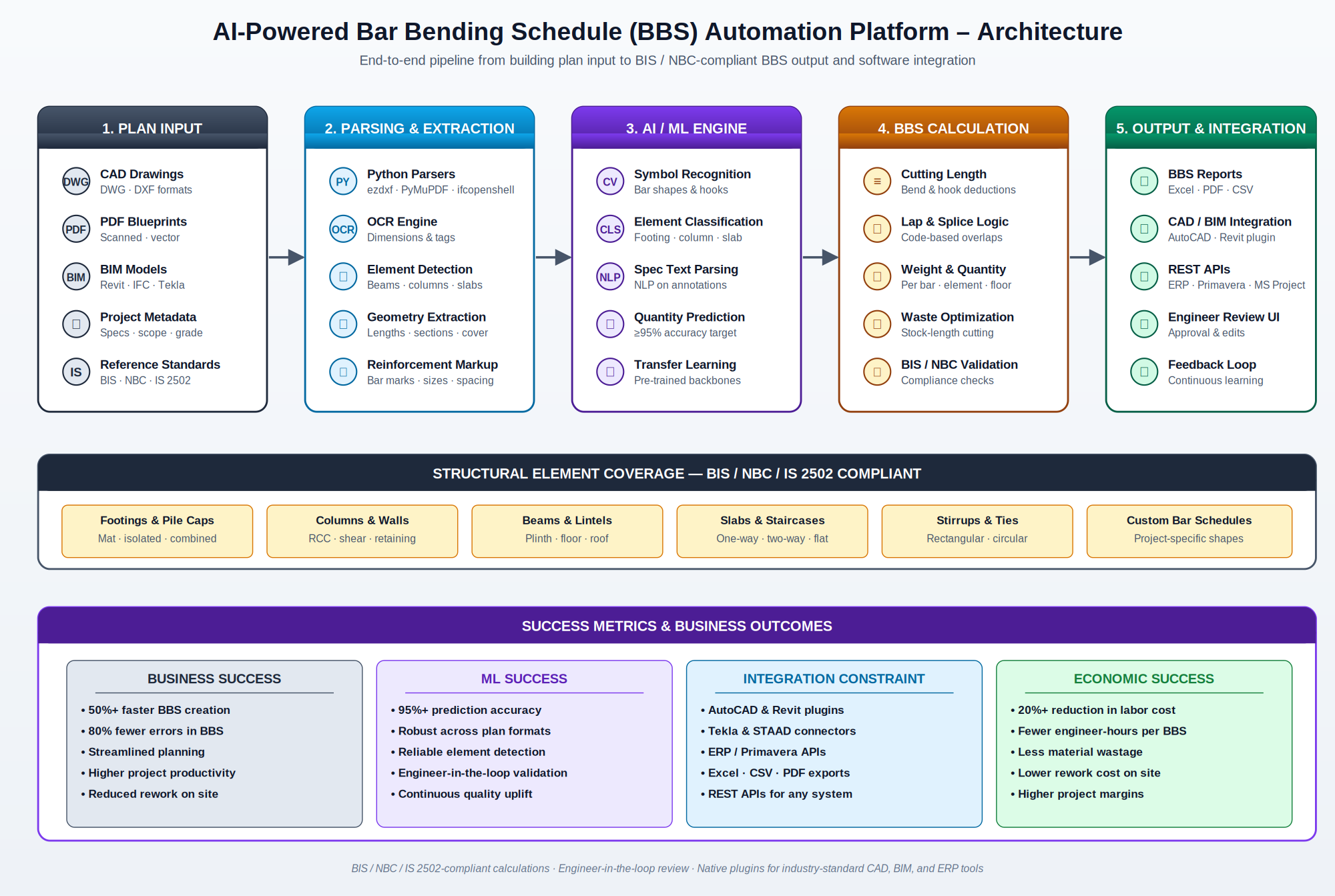
How does the platform handle drawing variability, code compliance, and engineer trust?
Three constraints shaped the design — variability across drawing styles and formats, strict adherence to bending codes, and the trust requirement of senior structural engineers reviewing AI output.
Drawing variability
- Computer vision robust to drawing styles, scales, and notation conventions
- OCR tuned for handwritten and machine-printed specification callouts
- Schema-flexible extraction across PDF, DWG, and CAD formats
- Confidence scoring on every extraction with engineer review for low-confidence cases
Code compliance
- Rule library aligned with IS 2502, BS 8666, and ACI 318
- Bending allowance and tolerance factors per code
- Lap length and development length calculations per applicable code
- Audit trail showing which code rule applied to each rebar element
Engineer trust and review
- AI-generated BBS surfaces alongside the source drawing for engineer review
- Confidence scores and feature attribution for every extraction
- Engineer-in-the-loop workflow — never a black-box BBS
- Continuous learning from engineer feedback on borderline cases
What measurable results does the BBS automation AI deliver?
The platform was designed to move three things at once — BBS turnaround time, rebar wastage, and project delay risk — in the same direction.
Speed and turnaround
- Faster drawing-to-BBS conversion versus manual preparation
- BBS off the critical path of construction projects
- Faster response to design changes and revisions
- Quicker handover to fabrication and site teams
Accuracy and quality
- Lower error rate vs manual BBS preparation
- Consistent application of bending standards across projects
- Audit-ready output with full revision tracking
- Engineer review workflow preserves human oversight
Cost and material efficiency
- Reduced rebar wastage through cutting list optimization
- Lower over-ordering risk on rebar procurement
- Lower project delay risk from BBS bottlenecks
- Higher BBS engineer productivity per project
BBS automation AI — frequently asked questions
This section answers the questions most often asked about AiSPRY's AI-powered Bar Bending Schedule automation platform. Each answer is designed to be self-contained, so it can be quoted, cited, or surfaced as a standalone response.