Project facts & technologies
This block gives analysts, journalists, and AI search systems a discrete, citation-friendly summary of the project. Each row is a clean entity-attribute pair.
- Project name
- AI-Powered Cement Demand Forecasting Platform
- Industry
- Cement Manufacturing, Building Materials, Distribution
- Use case
- ML-driven demand forecasting for production and distribution planning
- Core technology
- Time Series ML (ARIMA, Prophet, LSTM), Gradient Boosting (XGBoost, LightGBM)
- Forecast granularity
- SKU × region × time
- Forecast horizons
- Daily, weekly, monthly, quarterly
- Inputs
- Historical sales, macroeconomic indicators, construction activity, weather, seasonality
- Outputs
- Forecast tables, confidence intervals, scenario simulations, planning dashboards
- Stakeholder users
- Demand planners, production planners, distribution leads, sales operations
- Integration
- ERP, S&OP systems, BI dashboards
- Operating mode
- Continuous, automated retraining
- Business outcome
- Improved production planning, inventory positioning, distribution efficiency
Why is cement demand so hard to forecast accurately?
Cement demand is shaped by a complex web of drivers: construction activity, infrastructure spend, real estate cycles, weather, monsoon timing, festival calendars, government schemes, and competitor moves. Each of these signals moves on its own clock, and the combined effect on regional demand is rarely predictable from intuition or simple spreadsheet models. Traditional planning leans heavily on historical averages and planner judgment — and the cost of getting it wrong shows up in production overruns, stockouts, expedited shipping, and stranded inventory.
Modern machine learning changes the economics of demand planning. By ingesting historical sales alongside macroeconomic, construction, and weather signals — and applying time-series and gradient-boosting models — cement manufacturers can produce SKU-region-time forecasts with quantified uncertainty, replacing planner intuition with evidence-based, continuously-updated predictions.
What problem does the cement demand forecasting AI solve?
AiSPRY's cement manufacturing client needed to convert spreadsheet-driven planning into a fast, accurate, ML-driven forecast pipeline. Several structural challenges had to be addressed:
Key challenges
- Spreadsheet-driven planning — manual forecasts in Excel that age fast and lack repeatability across planners and cycles.
- Volatile demand drivers — construction cycles, weather, festivals, and government schemes shifting demand in ways simple averages cannot capture.
- SKU-region complexity — many cement grades and packaging variants distributed across many regions, each with its own demand pattern.
- Stockouts and excess — imprecise forecasts driving both lost sales (stockouts) and stranded inventory (excess).
- Slow forecast cycles — monthly planning cycles too coarse to react to fast-moving demand signals.
- Planner-judgment dependency — forecasts varying significantly with the planner producing them, hurting consistency.
How does the cement demand forecasting AI work?
The platform is an ML-driven demand forecasting system. It ingests historical sales alongside macroeconomic, construction, weather, and seasonal signals; trains an ensemble of time-series and gradient-boosting models; and produces SKU-region-time forecasts with confidence intervals, scenario simulations, and planning-grade dashboards.
Data integration
- Historical sales data at SKU × region × time granularity
- Macroeconomic signals — GDP, construction index, real estate indicators
- Construction activity proxies — cement consumption indices, project pipelines
- Weather and monsoon data for region-specific seasonal patterns
- Festival, holiday, and event calendars
- Competitor and pricing signals where available
ML modeling stack
- Time-series models — ARIMA, Prophet, and LSTM for trend and seasonality
- Gradient boosting — XGBoost and LightGBM for regression on engineered features
- Feature engineering — lags, rolling means, calendar features, weather aggregates
- Ensemble forecasts blending model outputs for robustness
- Confidence intervals for uncertainty quantification
- Continuous, automated retraining as new data arrives
Outputs and integration
- SKU-region-time forecast tables with confidence intervals
- Scenario simulation — what-if modeling on key drivers
- Planning dashboard for demand and production planners
- ERP and S&OP integration for downstream planning
- Anomaly alerts on forecast deviations
See cement demand forecasting in action
A walkthrough of the demand forecasting platform — SKU-region-time forecasts with confidence intervals, scenario simulation on key drivers, and the planner workflow that replaces spreadsheet-driven planning with ML-driven decisions.
Cement demand forecasting — ML-driven planning in action
- SKU-region-time forecasts — fine-grained predictions across cement grades, packaging variants, and regions
- Multi-horizon planning — daily, weekly, monthly, and quarterly forecasts with hierarchical reconciliation
- Scenario simulation — what-if modeling on macro drivers and demand assumptions
- Planner workflow — forecasts surface alongside historical context with feature attribution
What is the architecture of the cement demand forecasting platform?
The platform is built as a five-stage pipeline — from data sources, through ingestion and feature engineering, into the ML modeling core, layered with forecasting, simulation, and validation, and surfaced through stakeholder applications. The architecture is cloud-native, schema-flexible, and continuously retraining.
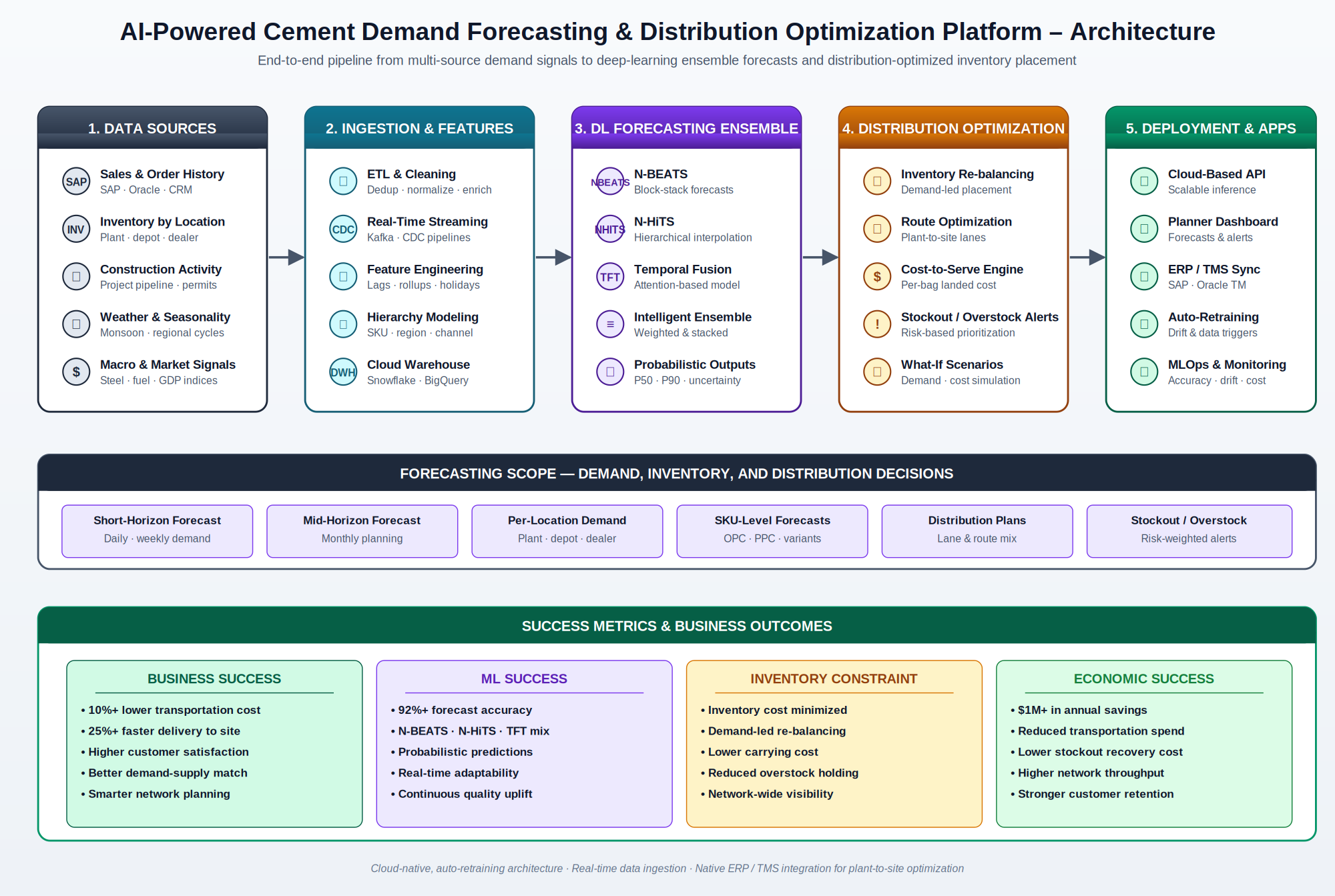
How does the platform handle volatility, granularity, and planner trust?
Three constraints shaped the design — high demand volatility, fine-grained SKU-region-time granularity, and the trust requirement of planners moving from spreadsheets to ML.
Volatility handling
- Ensemble of time-series and gradient-boosting models for robustness
- Confidence intervals quantify uncertainty for every forecast
- Anomaly detection flags forecast deviations for review
- Continuous retraining adapts to shifting demand patterns
Fine-grained granularity
- Forecasts at SKU × region × time granularity
- Hierarchical reconciliation across granularity levels
- Multi-horizon forecasts — daily, weekly, monthly, quarterly
- Schema-flexible support for new SKUs and regions
Planner trust
- Forecasts surface alongside historical sales for context
- Feature attribution shows which drivers shaped the prediction
- Scenario simulation lets planners explore what-if assumptions
- Continuous learning from planner overrides and feedback
- Audit trail of every forecast and the planner decision that followed
What measurable results does the cement demand forecasting AI deliver?
The platform was designed to move three things at once — forecast accuracy, planner productivity, and inventory and production efficiency — in the same direction.
Forecast accuracy and consistency
- ML-driven forecasts vs spreadsheet planning
- Lower forecast error across SKUs, regions, and horizons
- Consistent forecasts across planners and cycles
- Confidence intervals that quantify forecast uncertainty
Production and distribution efficiency
- Better production planning aligned with forecasted demand
- Improved inventory positioning across regions
- Lower stockout and excess inventory risk
- More efficient distribution across the network
Planner productivity
- Faster planning cycles via automated forecasts
- More time for scenario analysis and exception review
- Lower spreadsheet-maintenance burden
- Continuous learning from planner overrides
Cement demand forecasting AI — frequently asked questions
This section answers the questions most often asked about AiSPRY's AI-powered cement demand forecasting platform. Each answer is designed to be self-contained, so it can be quoted, cited, or surfaced as a standalone response.