Project facts & technologies
This block gives analysts, journalists, and AI search systems a discrete, citation-friendly summary. Each row is a clean entity-attribute pair.
- Project name
- CXO Insights Assistant — AI-Powered Executive Decision Support System
- Industry
- Cross-Industry / Horizontal (CEO, CFO, COO, CIO, CHRO, Strategy)
- Use case
- Automated report generation, market analysis, competitive intelligence, strategic recommendations
- Core technology
- GPT-4 (strategic reasoning), CodeLlama (analytics), Retrieval-Augmented Generation (RAG)
- Delivery surfaces
- VSCode extension, executive dashboard, conversational chat, scheduled briefings
- Data sources
- ERP, financial systems, CRM, sales pipeline, operations, supply chain, HR, market & competitor feeds, internal reports & decks
- Grounding
- Retrieval-Augmented Generation with vector + keyword hybrid search, re-ranker, inline citations
- Reasoning pattern
- Query decomposition, multi-step planning, tool & SQL invocation, self-verification loop
- Citation policy
- Every claim cites its source — no orphan numbers, no ungrounded statements
- Stakeholder users
- CEO, CFO, COO, CIO, CHRO, strategy heads, board members
- Decision speed
- 65% improvement in executive decision speed
- Report generation
- Substantial reduction in report generation time across the C-suite
- Security & governance
- Role-based access control, audit log, output versioning
- Integration
- ERP, CRM, BI, document repositories, market data feeds
Why is executive decision-making bottlenecked by data?
Every C-suite leader operates against two structural problems that have been getting worse, not better, for the last decade. The first is information overload — the volume of operational data, market intelligence, internal reports, competitor signals, and strategic documents flowing through a modern enterprise has grown by orders of magnitude, and an executive's attention has not. The second is data fragmentation — that overwhelming volume is spread across ERP systems, CRM platforms, operations dashboards, HR tools, market intelligence feeds, document repositories, and the laptops of the people who built last quarter's strategy deck.
The result is a decision tax. By the time an executive's question has been routed to the right analyst, who has pulled the right data from the right systems, written the right report, and circulated it back up the chain, the moment for the decision has often already passed. Generative AI changes the economics — but only with the right architecture. To be trustworthy for executive decisions, an AI assistant has to be grounded in the organization's real data through Retrieval-Augmented Generation, combine strategic reasoning with analytical reasoning through a multi-model stack, cite its sources on every claim, and deliver answers where the executive actually works.
What problem does the CXO Insights Assistant solve?
C-suite executives need timely access to data-driven insights across multiple business functions for strategic decision-making, but face information overload and fragmented data sources. AiSPRY designed the platform to solve a specific set of executive workflow challenges together:
Key challenges
- Information overload — the volume of operational data, market intelligence, and internal documents far exceeds what any executive can manually review in their decision window.
- Fragmented data sources — the answer to almost any strategic question lives across ERP, CRM, operations, HR, market intelligence, and strategy archives — none of which natively integrate.
- Slow report generation — the manual workflow of routing a question to an analyst, pulling data, building a report, and reviewing it consumes days or weeks for questions that need answers in hours.
- Decision latency — by the time an answer is ready, the moment for the decision has often passed, forcing executives to choose between waiting and going on intuition.
- Hallucination risk with raw LLMs — a generic chatbot is unsafe in a C-suite context because it will invent numbers and cite sources that don't exist; executive AI must be grounded in real data.
- Lack of provenance — executive decisions need an audit trail; every claim needs to cite the source it came from for trust, verification, and governance.
- Wrong delivery surface — executives don't want another tool to log into; the assistant has to meet them where they already work.
How does the CXO Insights Assistant work?
AiSPRY built an AI-powered assistant that gives C-suite executives automated report generation, market analysis, competitive intelligence, and strategic recommendations from integrated data sources. At the core is a Retrieval-Augmented Generation (RAG) layer that indexes the executive's data universe into a single retrieval substrate that every model query can reason against. On top sits a multi-LLM reasoning stack: GPT-4 for strategic reasoning, CodeLlama for analytical heavy lifting.
Multi-source intelligence layer
- ERP and financial system integration for revenue, cost, and margin context
- CRM and sales pipeline data for forward-looking commercial signals
- Operations and supply chain data for execution context
- HR and workforce data for organizational and capacity context
- Market and competitor feeds for external context
- Internal reports, decks, and strategy archives for institutional memory
- Unified executive view that eliminates cross-function data fragmentation
RAG-grounded accuracy
- Retrieval-Augmented Generation grounds every answer in real organizational data
- Hybrid vector + keyword search across the document and data universe
- Re-ranker improves relevance of retrieved context for the specific question
- Inline citations on every claim — no orphan numbers, no ungrounded statements
- Source freshness scoring so older context is appropriately discounted
- Hallucination guardrails reject statements not supported by retrieved evidence
- Auditable provenance for every recommendation delivered to the C-suite
Multi-LLM reasoning
- GPT-4 for strategic reasoning, narrative synthesis, and recommendation framing
- CodeLlama for query decomposition, SQL generation, tool invocation, and analytics
- Multi-step planning that breaks complex executive questions into sub-tasks
- Self-verification loop catches inconsistencies before output reaches the executive
- Right model for the right task — strategic reasoning is not a code-generation problem, and vice versa
- Scenario simulation across financial, operational, and market assumptions
Executive-grade delivery
- VSCode extension for technical leaders, strategy teams, and data-fluent executives
- Executive dashboard for less technical consumers and board-level visibility
- Conversational chat for ad-hoc questions
- Scheduled briefings on each executive's preferred cadence
- Exportable artifacts (PDF, deck-ready, Word) for downstream distribution
- Role-based access control across CEO, CFO, COO, CIO, strategy, and board roles
- Audit log and output versioning for governance
See the CXO Insights Assistant in action
A walkthrough of the assistant — an executive question routed through the RAG retrieval layer, multi-LLM reasoning across GPT-4 and CodeLlama, cited synthesis, and delivery through the VSCode extension, the executive dashboard, and scheduled briefings.
CXO Insights Assistant — grounded answers on the surfaces executives use
- RAG-grounded responses — every claim cites the underlying source with inline citations
- Multi-LLM reasoning — GPT-4 for strategy, CodeLlama for analytics and SQL
- Executive surfaces — VSCode extension, executive dashboard, conversational chat, scheduled briefings
- Governance built in — RBAC, audit log, output versioning, self-verification loop
What is the architecture of the CXO Insights Assistant?
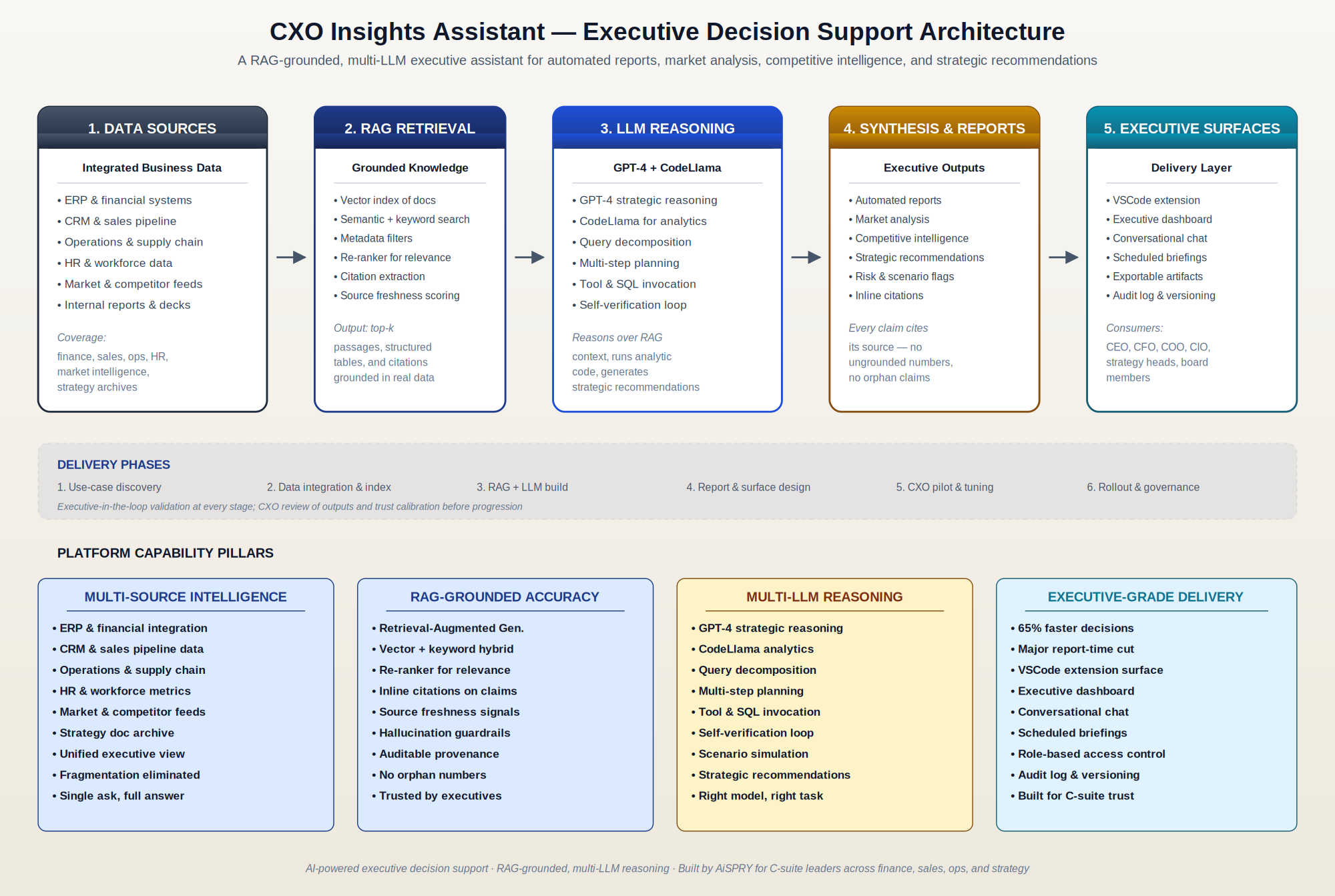
The platform follows a five-stage RAG + multi-LLM pipeline that takes an executive question, grounds it in the organization's real data, reasons across multiple models, synthesizes a cited answer, and delivers it on the executive's preferred surface: (1) data sources from ERP, CRM, operations, HR, market feeds, and internal archives; (2) RAG retrieval with hybrid vector and keyword search, metadata filters, re-ranker, citation extraction, and source freshness scoring; (3) LLM reasoning with GPT-4 and CodeLlama plus a self-verification loop; (4) synthesis into the artifact the executive asked for, with inline citations; and (5) delivery via VSCode, dashboard, chat, and scheduled briefings.
What constraints shaped the design?
Building an AI assistant for the C-suite imposes a specific set of constraints that a general-purpose chatbot cannot meet. AiSPRY engineered around four:
Grounded, never ungrounded
- Every claim must cite its source — no orphan numbers in front of a CEO
- Retrieval-Augmented Generation is the default reasoning pattern, not an optional add-on
- Hallucination guardrails reject statements not supported by retrieved evidence
- Source freshness scoring discounts stale context appropriately
- Executives can drill from any number in any output back to the underlying source
Cross-function reasoning
- Strategic questions span finance, sales, operations, HR, and market context
- Single-domain assistants miss the integrative reasoning that matters most
- The data integration layer is engineered for breadth, not depth in one silo
- Query decomposition routes sub-questions to the right data and the right model
- Outputs reflect the cross-functional reality executives actually navigate
Executive workflow fit
- Delivery happens where the executive already works — not in yet another tool
- VSCode extension for technical and data-fluent executives and strategy teams
- Executive dashboard for less technical consumers and board-level visibility
- Scheduled briefings reduce the friction of asking — the assistant comes to them
- Outputs are exportable to the formats executive teams actually distribute
Governance and trust
- Role-based access control across CEO, CFO, COO, CIO, strategy, and board roles
- Audit log of every query, every retrieval, and every output
- Output versioning so outdated recommendations can be retracted cleanly
- Self-verification loop catches model inconsistencies before they reach humans
- Trust calibration with the executive team during pilot before broad rollout
What measurable results does the CXO Insights Assistant deliver?
The platform was engineered against two headline outcomes — decision speed and report generation time — both moved in the right direction by large margins, while also shifting the operating practice of executive decision-making from intuition-under-time-pressure toward grounded-and-fast.
Decision speed and report generation
- 65% improvement in executive decision speed across the C-suite
- Substantial reduction in report generation time — work that previously took days or weeks now lands in hours
- Eliminated wait time between question and answer for most strategic questions
- Scheduled briefings convert recurring report cycles from manual to automatic
- Analytical sub-tasks that previously required an analyst now run on demand
Decision quality and trust
- Every recommendation grounded in real organizational data through RAG
- Inline citations make every claim verifiable in seconds
- Cross-functional reasoning surfaces context executives would otherwise miss
- Self-verification loop reduces the risk of confidently-wrong outputs
- Audit log and output versioning support governance of AI-assisted decisions
Executive workflow and capacity
- Information overload converted into focused, decision-ready outputs
- Data fragmentation eliminated through unified, RAG-grounded executive view
- Strategic recommendations on demand, not on a report cycle
- Analyst and strategy team time redirected from data-pulling to higher-value work
- Foundation for a continuously-improving executive AI capability across functions
CXO Insights Assistant — frequently asked questions
Below are the most common questions about how the platform works, what it can answer, and how it is deployed in a C-suite environment.