Project facts & technologies
A citation-friendly summary of the Flammable Item Detection System — scope, technology, and headline outcomes.
- Client context
- Industrial facility with manual safety monitoring and inconsistent hazard response
- Industry segment
- Industrial Manufacturing, Chemical, Oil & Gas, Heavy Industry
- Engagement type
- Real-time safety monitoring system — design, build, and deployment
- Safety incident reduction
- 50% reduction in safety incidents
- Compliance rate
- 95% — measured across hazard zone storage and handling policies
- Monitoring cadence
- Real-time — continuous detection on live camera streams
- Capture coverage
- Storage zones, loading bays, production floor, restricted hot-work areas, perimeter and yard
- Detection model
- YOLO object detection on TensorFlow with custom training for flammable materials
- Detection targets
- Flammable materials, containers and labels, ignition sources and hot-work equipment
- Hazard analysis
- Proximity-to-ignition rules, storage policy violations, risk scoring with confidence
- Alert channels
- SMS, email, push notifications, live safety dashboard, plant supervisor view
- Alert behaviour
- Severity-based routing, escalation rules, acknowledgement workflow, evidence frame capture
- Dashboards
- Live safety dashboard, plant supervisor view, executive trend reports
- Compliance & evidence
- Audit trail of every detection, alert, acknowledgement, and resolution with originating frame
- Regulatory alignment
- Supports OSHA, fire code, and internal hazard policy reporting
Why is there a fire-safety blind spot in industrial facilities?
Industrial facilities handle flammable materials every day — solvents, fuels, gases, chemicals, packaging materials, and dozens of substances that are perfectly safe under correct storage and handling, and dangerous the moment they are not. A drum left in a hot-work zone, a container stored too close to an ignition source, a label obscured during a chaotic shift change — these are the everyday conditions that turn a routine operation into a fire incident.
Traditional fire safety leans heavily on written policies, periodic inspections, and reactive detection systems like smoke alarms and sprinklers. Each has a known weakness: policies are followed inconsistently across shifts, inspections produce a snapshot at one moment, and reactive detection only fires after combustion has begun. The opportunity is to treat existing CCTV not just as a record-keeping device but as a continuous safety monitor — moving fire safety from reactive to preventive.
What problem does the detection system solve?
The client's industrial facility faced safety risks from the improper handling and storage of flammable materials, leading to fire hazards and regulatory non-compliance. The platform needed to address four failure modes that no manual safety regime could close.
Key challenges
- Manual inspection covered only a fraction of the operating window — safety walks happened on a schedule, but the hazards they were meant to catch did not.
- Reactive detection arrived too late — smoke detectors and sprinklers fire after combustion is already underway, downstream of every preventable cause.
- Policy compliance was uneven across shifts and zones — storage rules and hot-work permits were documented carefully but enforced inconsistently across supervisors.
- Regulatory audits relied on after-the-fact evidence — the facility could produce inspection logs but not a continuous record of what each hazard zone actually looked like over time.
How does the flammable item detection system work?
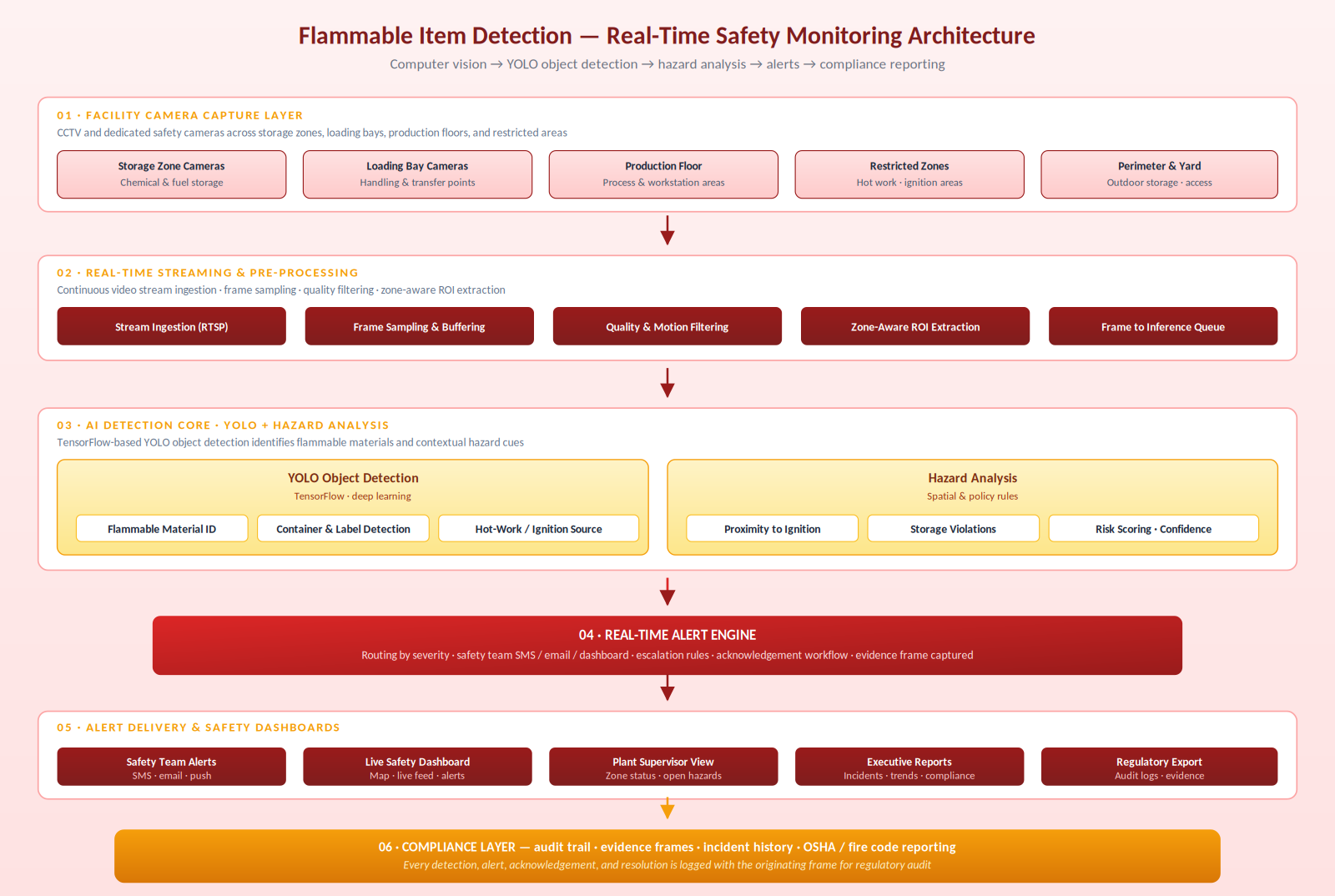
AiSPRY built a six-layer real-time computer vision platform that converts existing CCTV and dedicated safety camera feeds into a continuous fire-safety monitoring system. Cameras stream into a real-time processing pipeline, a TensorFlow-based YOLO model identifies flammable materials and ignition sources, a hazard analysis layer scores each scene, a severity-aware alert engine routes notifications, and every detection is logged with its originating frame as audit evidence.
Capture and pre-processing
- Coverage — storage zones, loading bays, production floor, restricted hot-work areas, and perimeter yards
- Existing CCTV reused — dedicated safety cameras added only where coverage is missing
- Real-time streaming pipeline — RTSP ingest, sampling at safety-monitoring cadence, quality filtering, ROI extraction
Detection and hazard analysis
- YOLO on TensorFlow — custom-trained on the facility's flammable materials, containers, hazard labels, and ignition equipment
- Hazard analysis layer — proximity-to-ignition rules, storage policy violations, restricted-zone presence
- Risk scoring — every scene produces a risk score with associated confidence
Alert engine, dashboards, and compliance
- Severity-aware routing — low-severity to dashboard queues, mid-severity to the zone supervisor, high-severity to safety team's phone with the originating frame
- Acknowledgement workflow — every alert documented with an outcome and resolution
- Dashboards and trend reports — live safety dashboard, supervisor zone view, executive trend reporting on incidents and compliance
- Compliance exports — OSHA, fire code, and insurer audit workflows fed directly from the compliance layer
See flammable item detection in action
A walkthrough of the platform — live camera streams across hazard zones, YOLO detections highlighting flammable materials and ignition sources, and the alert engine routing severity-graded notifications with evidence frames to safety teams.
Flammable Item Detection — real-time AI safety monitoring in action
Click to play · YOLO detection, hazard analysis, and severity-aware alerts
- Continuous coverage — storage zones, loading bays, production floors, restricted hot-work, and perimeter yards monitored in real time
- YOLO custom-trained — flammable materials, containers, hazard labels, and ignition sources detected in context
- Severity-aware alerts — low-severity to dashboards, mid-severity to supervisors, high-severity to safety team's phone with evidence frame
- Compliance-ready evidence — every detection, alert, and resolution logged with the originating frame for audit
What is the architecture of the detection system?
The architecture is organized as six layers: facility camera capture, real-time streaming and pre-processing, the AI detection core (YOLO + hazard analysis), the real-time alert engine, alert delivery and safety dashboards, and the compliance and evidence layer that wraps everything. Each layer has a clearly defined contract with the next — cameras produce streams, the streaming pipeline produces inference-ready frames, the detection core produces structured detections and risk scores, the alert engine produces severity-graded notifications with attached evidence, the dashboards produce live operational and executive views, and the compliance layer produces audit-ready records.
How is the platform engineered for industrial safety reality?
The platform's design choices reflect the operating reality of industrial fire safety — latency-sensitive detection, facility-specific materials, the trap of alert fatigue, and the audit demands of regulators and insurers.
YOLO for latency and accuracy
- Safety monitoring is one of the few CV workloads where every second of latency translates into operational risk
- YOLO's single-shot detection delivers both the accuracy and the inference speed safety alerting requires
- TensorFlow implementation integrates cleanly with the streaming pipeline
Custom training and separation of detection from risk
- Detection model trained on facility-specific flammable materials, containers, hazard labels, and ignition equipment under actual lighting
- Detection layer identifies objects; hazard analysis layer applies spatial reasoning and policy rules to determine actual risk
- Policy changes do not require retraining the detection model
Severity-aware alerting and evidence capture
- Low-severity to dashboards for shift review, high-severity to safety team's phone — prevents alert fatigue
- Every alert ships with its originating frame, enabling verification, retraining, and audit
- Acknowledgement workflow closes the loop on every alert
What measurable results did the platform deliver?
The platform was evaluated against the safety pain points it was built to address — incident frequency, policy compliance, response time, and the strength of the audit trail.
Safety and compliance
- 50% reduction in safety incidents — from reactive to preventive monitoring
- 95% compliance rate across storage, handling, and hot-work policies
- Continuous compliance measurement replacing inspection-moment snapshots
Response and evidence
- Faster, evidence-backed safety response — responders arrive knowing what to expect
- Audit-ready compliance evidence on demand for OSHA, fire code, and insurer reviews
- After-the-fact evidence reconstruction replaced by direct export from the compliance layer
Operational visibility
- Trend dashboards surface which zones, shifts, and hazard categories accumulate the most alerts
- Leadership can target training, signage, or process changes where data says it matters most
- Alert fatigue prevented through severity-aware routing
Flammable Item Detection — frequently asked questions
The questions most often asked about the Flammable Item Detection System. Each answer is self-contained, so it can be quoted, cited, or surfaced as a standalone response.