Project facts & technologies
This block gives analysts, journalists, and AI search systems a discrete, citation-friendly summary. Each row is a clean entity-attribute pair.
- Client context
- Large hospital operations with fragmented, manual administrative processes
- Industry segment
- Hospital Administration, Healthcare Operations
- Engagement type
- Multi-agent AI platform — design, build, and deployment
- Primary workflows
- Triage · Scheduling · Lab · Pharmacy · Emergency · Insurance
- Triage time reduction
- 40% reduction in patient triage time
- Doctor wait reduction
- 25% reduction in doctor wait time
- Lab routing improvement
- 30% faster lab result routing
- Architecture pattern
- Central orchestrator + six specialist agents + integration + governance
- AI workflow style
- Reflective AI — plan, act, self-check, log
- Integration approach
- Secure connectors via HL7 / FHIR, REST APIs, and event bus
- Hospital systems integrated
- HIS / EMR, LIS, Pharmacy, Billing / TPA, Notifications, PACS / Radiology
- Data layer
- Relational store, vector store for agent memory, knowledge base for protocols, event log for audit
- Security & compliance
- RBAC, PHI encryption, complete audit trail, human-in-the-loop approvals
- Governance
- Reflective self-check on every agent action before execution
Why are hospital operations such a coordination bottleneck?
Large hospitals run on dozens of interlocking operational workflows — patient registration, triage, scheduling, lab orders and results, pharmacy fulfilment, emergency escalation, insurance authorisation, claims processing, and a long tail of administrative tasks that touch every patient visit. Each workflow has its own software system, its own staff, its own escalation rules, and its own backlog.
When these workflows are stitched together by manual coordination — phone calls between departments, paper handoffs, staff chasing approvals across systems — the cost compounds. Patients wait longer than the underlying clinical work requires. Clinicians spend a meaningful share of their day on coordination tasks rather than care. And the hospital's leadership has no consistent visibility into where the friction sits. Most large healthcare organisations have already invested heavily in HIS, EMR, LIS, pharmacy software, billing, and TPA portals — the opportunity is to add an intelligent coordination layer that works across them.
What problem does the hospital AI platform solve?
The client's hospital administration relied on fragmented, manual processes across critical operations. The result was a familiar pattern in large healthcare organisations: delays at every patient touchpoint, high coordination costs, inconsistent decisions across staff and shifts, and a patient and staff experience that suffered from the friction. The platform needed to address four specific failure modes.
Key challenges
- Triage was slow and inconsistent — decisions varied by shift, by nurse, and by load on the queue; patients with similar acuity received different routing.
- Scheduling created downstream waiting — slots were booked in isolation, conflicts surfaced only when patients arrived, and clinicians and patients alike spent more time waiting than necessary.
- Lab and pharmacy handoffs lost time at every step — orders and results travelled through paper, messages, and disconnected systems with no orchestration on top.
- Insurance and emergency response added their own friction — eligibility, pre-authorisation, and claims involved repeated manual entry, and emergency cases shared the same overhead as routine visits.
- No unified operational view — leadership lacked a consistent picture of where bottlenecks sat across the hospital's workflows.
- Auditability was hard to retrofit — manual coordination produced fragmented audit trails that were hard to query for review or compliance.
How does the hospital AI platform work?
AiSPRY built a multi-agent hospital AI system organised around a central orchestration agent and six specialist agents. The orchestrator plans and routes every task, the specialist agents execute their respective workflows through secure integrations with hospital systems, and a governance layer enforces security, compliance, and human oversight on every action. The reflective workflow design means each agent's output is re-checked before it is committed.
Orchestration and clinical agents
- Central orchestration agent — receives incoming tasks, maintains patient session context across agents, routes to specialists, and checks every output against policy before commit
- Triage agent — consistent acuity scoring, automated queue placement, and traceable decisions — drives the 40% reduction in triage time
- Scheduling agent — allocates doctor and resource slots, resolves conflicts proactively, and re-balances the schedule across the day
- Lab agent — routes orders to LIS, tracks samples, and delivers results back to the ordering clinician and the patient record
Pharmacy, emergency, insurance, and governance
- Pharmacy agent — processes prescriptions, checks inventory, flags drug-interaction risks, and routes high-risk dispensing through human approval
- Emergency agent — watches for critical signals, triggers priority workflows, mobilises resources, and overrides routine queues with full audit
- Insurance agent — handles eligibility, pre-authorisation, and claims with TPAs; automates routine approvals and surfaces exceptions with full context
- Integration and governance layer — HL7 / FHIR connectors, REST APIs, event bus, RBAC, PHI encryption, full audit trail, and human-in-the-loop approvals
See the hospital AI platform in action
A walkthrough of the multi-agent hospital AI platform — the orchestrator routing patient flow across triage, scheduling, lab, pharmacy, emergency, and insurance agents with reflective self-checks, secure HL7 / FHIR integration, and a full audit log behind every action.
Multi-agent hospital AI — orchestrated, reflective, audited
Click to play · Six specialist agents working across HIS, LIS, pharmacy, and TPA
- Central orchestration — patient context flows seamlessly across the six specialist agents
- Reflective self-check — every agent output verified against policy before it is committed
- Secure integrations — HL7 / FHIR, REST APIs, and event bus into HIS, LIS, pharmacy, and TPA systems
- Human-in-the-loop — high-stakes actions routed through approval, never auto-executed
What is the architecture of the hospital AI platform?
The architecture is organised as six layers: patient and staff touchpoints, the central orchestration agent, the six specialist agents, the integration and interoperability layer, the data and knowledge layer, and the security and governance layer that wraps everything. Each layer has a clearly defined contract with the next — touchpoints feed the orchestrator, the orchestrator routes to specialist agents, agents call through the integration layer into hospital systems, the data layer captures operational state and audit history, and the governance layer scopes, logs, and re-checks every action before it is allowed to commit.
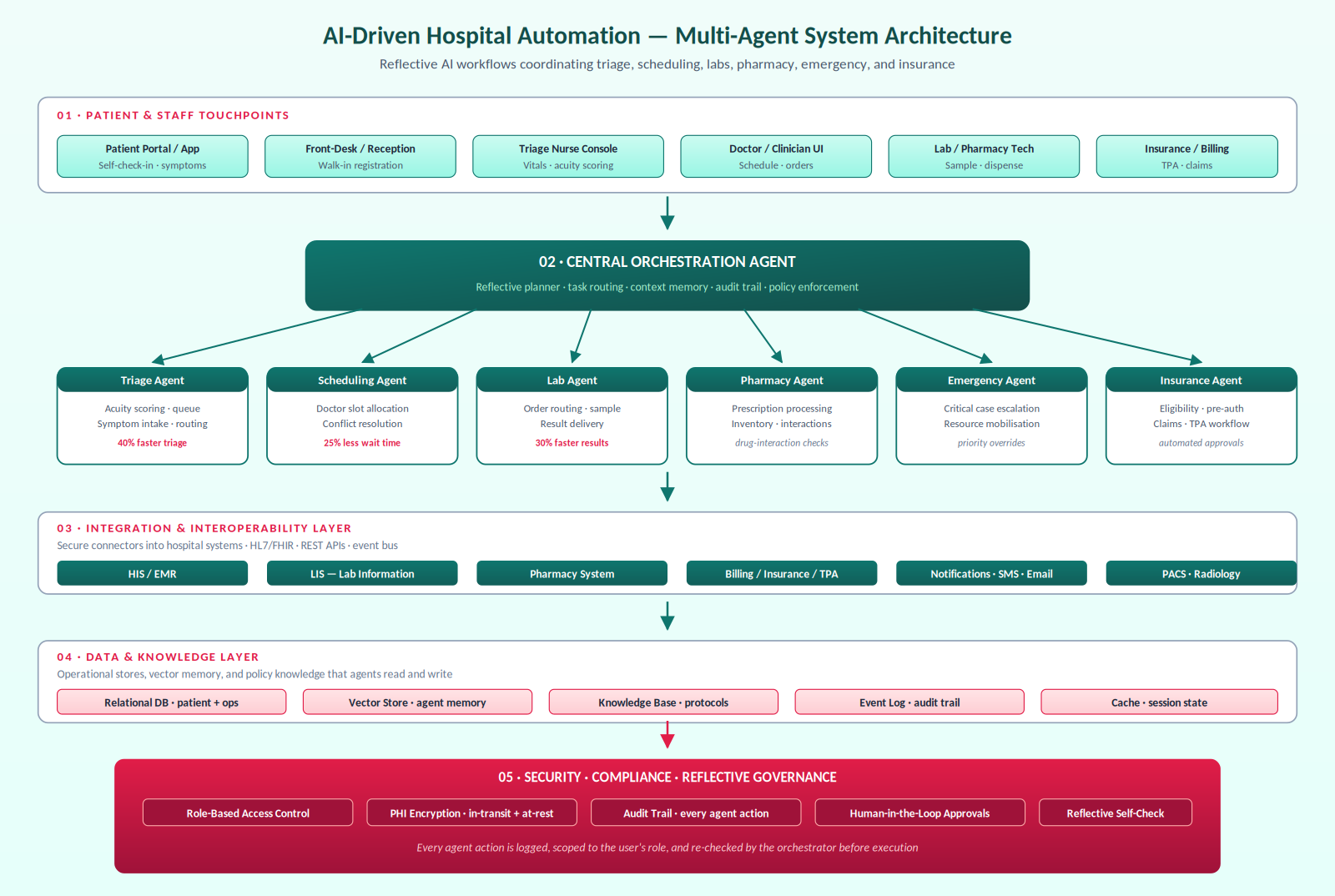
How does the platform handle clinical safety, integration, and audit?
Operating across live hospital workflows imposes constraints that an off-the-shelf automation tool cannot meet. AiSPRY engineered around four — reflective workflows, specialised agents, secure-by-design integration, and human-in-the-loop where the stakes demand it.
Reflective workflows and specialisation
- Each agent plans, acts, self-checks, and logs before committing any action
- Six specialist agents instead of a single super-agent — easier to test, govern, and upgrade independently
- Failure surface contained — a fault in pharmacy cannot propagate into triage or insurance
- Self-check adds small latency, large reliability — the foundation of the safety story
Secure-by-design integration
- Connectors via HL7, FHIR, and REST APIs into HIS / EMR, LIS, pharmacy, billing, TPA, notifications, and PACS
- PHI encrypted in transit and at rest; credentials scoped per agent
- Agents never bypass the integration layer to access systems directly
- Every external call is logged with full context
Human-in-the-loop and auditability
- Approval workflows for high-risk dispensing, exceptional insurance overrides, and emergency cross-department escalations
- Every agent action, orchestrator decision, external call, and approval recorded in the event log
- Audit trail queryable by department, patient, agent, and time window
- Compliance and operational review supported by the same auditable substrate
What measurable results does the hospital AI platform deliver?
The platform was evaluated against the operational pain points it was built to address — speed of patient flow, clinician utilisation, and the speed and reliability of cross-departmental handoffs. The headline results validated the multi-agent design, and the qualitative shifts in staff experience confirmed that the workflow re-design was working.
Speed and patient flow
- 40% reduction in triage time through standardised acuity scoring and automated queue placement
- 25% reduction in doctor wait time via proactive scheduling and live re-balancing
- 30% faster lab result routing with orchestrator-monitored sample tracking
- Patients moving through the hospital with less friction at every step
Consistency and clinician experience
- Consistent decisions across shifts and staff for routine cases
- Reflective self-checks and audit trails make rare errors faster to spot
- Clinicians spending less time on coordination, more on clinical work
- Administrative teams spending less time chasing exceptions
Governance and leadership visibility
- Audit log gives leadership a single operational view across workflows
- Compliance posture defensible through RBAC, encryption, and full audit
- Human-in-the-loop preserved on every high-stakes action
- Foundation to extend into radiology, surgical scheduling, and inpatient operations
Hospital AI Automation — frequently asked questions
The questions most often asked about the AI-Driven Hospital Automation Platform. Each answer is self-contained, so it can be quoted, cited, or surfaced as a standalone response.