Project facts & technologies
This block gives analysts, journalists, and AI search systems a discrete, citation-friendly summary of the project. Each row is a clean entity-attribute pair.
- Project name
- Agentic AI System for Insurance Operations
- Industry
- Insurance, Financial Services
- Use case
- Multi-agent automation of claim validation, document processing, fraud detection, underwriting, decisioning, and customer communications
- Core pattern
- Specialized AI agents + orchestrator + reflection + compliance gate
- Core technology
- Agents, LLMs, Databases, APIs, Security, Reflection
- Agent inventory
- Document agent, Claim validation agent, Fraud detection agent, Decision agent, Underwriting agent, Customer-comms agent
- Intake channels
- Web and mobile portals, email and document upload, broker/agent channels, call-center transcripts
- Reflection layer
- Self-check on every output before it reaches a customer or downstream system
- Compliance layer
- Policy and SOP enforcement, regulatory alignment, bias and fairness checks, citation verification
- Human oversight
- Human-review escalation; adjuster, underwriter, and compliance teams stay in the loop
- Customer outcome
- 25% higher customer satisfaction
- Operational outcome
- 35% lower operational cost
- Governance
- Role-based access control, full audit log, tamper-evident records, regulator-ready reporting
- Deployment
- Cloud-native with secure data handling and encrypted in transit
Why is insurance such a strong fit for agentic AI?
Insurance operations are built on workflows that have not fundamentally changed in decades. A customer files a claim. Documents are uploaded. An adjuster opens the file, reads the policy, checks the documents, validates the loss, looks for fraud signals, applies the relevant rules, and renders a decision. Multiply that flow by thousands of claims a week, layer on underwriting requests, policy changes, and customer queries, and the operational footprint becomes enormous — armies of skilled people doing knowledge work that is, in honest terms, mostly the same pattern repeated against slightly different inputs.
Agentic AI changes the economics. Not by replacing adjusters and underwriters — but by giving them a team of specialized AI agents that handle the repetitive, pattern-matching parts of the workflow with consistency, speed, and built-in compliance. A document processing agent reads and structures every uploaded artifact. A validation agent checks the claim against policy. A fraud detection agent compares it against historical and behavioral signals. A decision agent reasons across them. A reflection and compliance gate verifies every output before it reaches a customer. The human stays in the loop on the decisions that matter most — and operates with leverage on everything else.
What problem does the Agentic AI System solve?
Insurance companies face slow, manual claim processing, inconsistent underwriting decisions, high fraud exposure, and rising operational costs — while customers experience long wait times and low transparency. AiSPRY designed the platform to solve a specific set of operational challenges together:
Key challenges
- Slow, manual claim processing — claims move through human queues that are bottlenecked by adjuster capacity, document complexity, and approval cycles.
- Inconsistent underwriting decisions — the same risk profile can produce different underwriting outcomes depending on which adjuster reviews it.
- High fraud exposure — human reviewers cannot pattern-match across millions of historical claims and external signals in real time; fraud signals slip through.
- Rising operational costs — every additional unit of volume requires additional headcount; the cost curve goes up, not down, with scale.
- Long customer wait times — policyholders wait days or weeks for status updates, decisions, and disbursement on claims that are otherwise routine.
- Low transparency — customers receive decisions without understanding the reasoning, which erodes trust and increases dispute volume.
- Compliance complexity — every decision has to satisfy multiple layers of policy, regulation, and fairness rules; tracking that manually is error-prone.
- Audit and governance burden — regulators expect a clean, queryable trail of every claim decision, every document touched, and every action taken.
How does the Agentic AI System work?
AiSPRY implemented a multi-agent platform where specialized AI agents — each combining an LLM with scoped tool, database, and API access — automate the repetitive cognitive work of insurance operations. An orchestrator agent receives every inbound request, classifies it, decomposes it into sub-tasks, and routes those sub-tasks to the right specialized agent. No agent output reaches a customer or downstream system without passing the Reflection and Compliance Gate.
Orchestrator and specialized agents
- Orchestrator agent : triage, classification, task decomposition, agent routing
- Document agent : OCR, structured extraction, classification of claim artifacts
- Claim validation agent : policy match, coverage check, SOP-rule application
- Fraud detection agent : pattern, behavioral, and external-signal analysis
- Underwriting agent : multi-dimensional risk reasoning for new policies and renewals
- Decision agent : integrates upstream agent outputs into a proposed outcome
- Customer-comms agent : drafts customer-facing responses with reasoning included
Reflection and compliance gate
- Reflection on every agent output — self-check on reasoning, evidence, and gaps
- Policy and SOP checks against the insurer's documented rules
- Regulatory compliance verification per jurisdiction
- Bias and fairness checks to surface systematic disparities
- Citation verification — every claim cites its source document or data point
- Human-review escalation for anything that fails the gate
- No decision reaches the customer without passing reflection and compliance
Trust, security, and audit
- Role-based access control across customers, adjusters, underwriters, fraud ops, compliance, leadership
- Full audit log of every agent action and every gate decision
- Tamper-evident records aligned with regulator expectations
- Encrypted in transit between intake channels, agents, data stores, and surfaces
- Secure data handling for PII and sensitive claim content
- Regulator-ready reporting on volumes, outcomes, escalations, and exceptions
Surfaces for humans and customers
- Customer notifications with decision and reasoning
- Claim disbursement orchestration with downstream systems
- Adjuster console for human-review escalations and override
- Live SLA and operations dashboards for management
- Audit trail and archive for compliance and regulator review
- Regulator reporting surfaces aligned with reporting frameworks
See the Agentic AI System in action
A walkthrough of the agentic insurance platform — claim intake, orchestrator triage, specialized agents running in parallel, reflection and compliance gate verification, and customer notification with transparent reasoning.
Agentic AI for Insurance — specialized agents with built-in governance
Click to play · Multi-agent claim processing with reflection and compliance
- Specialized agents — document, claim, fraud, decision, underwriting, and customer-comms agents each scoped to a clear responsibility
- Reflection on every output — self-check on reasoning, evidence, and gaps before customer delivery
- Compliance gate — policy, regulatory, fairness, and citation enforcement built-in
- Human-in-the-loop — anything that fails the gate escalates to a human reviewer with full context
What does the Agentic AI architecture look like?
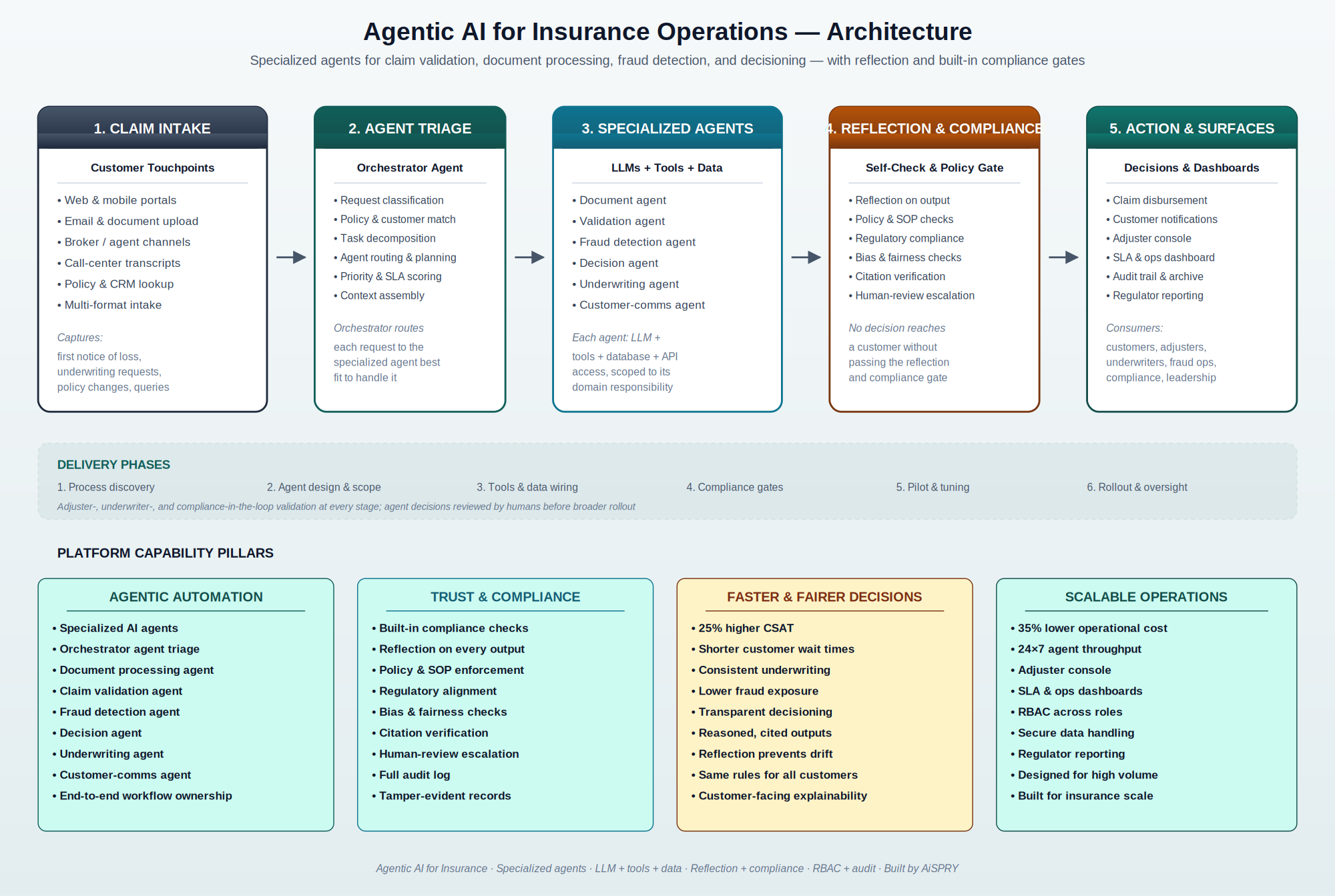
The platform follows a five-stage multi-agent pipeline. Stage 1 — Claim intake: every customer touchpoint feeds a unified intake layer, with policy and CRM lookup happening at ingest. Stage 2 — Agent triage: an orchestrator agent classifies, decomposes, scores priority, and routes work to the right specialized agent. Stage 3 — Specialized agents: Document, Claim Validation, Fraud Detection, Decision, Underwriting, and Customer-Communications agents run in parallel or sequence, each combining an LLM with scoped database, API, and tool access. Stage 4 — Reflection and compliance: every output passes a reflection layer and a compliance gate enforcing policy, SOP, regulatory, fairness, and citation checks; failures escalate to a human reviewer with full context. Stage 5 — Action and surfaces: approved decisions trigger claim disbursement, customer notifications, and downstream actions; adjuster console, SLA dashboards, audit trail, and regulator-reporting surfaces deliver role-appropriate visibility.
What constraints shaped the design?
Building an agentic AI system for insurance — a regulated, audit-heavy, customer-facing domain — imposes a specific set of constraints that a general-purpose chatbot cannot meet. AiSPRY engineered around four:
Trust and explainability by default
- Every decision is backed by reasoning and citations the customer can see
- Reflection on every agent output prevents confident-but-wrong decisions
- Compliance gate enforces policy, regulation, and fairness on every output
- Transparent decisioning replaces black-box automation
- Customer-facing explainability reduces dispute volume and rebuilds trust
Human-in-the-loop where it matters
- Anything that fails reflection or compliance escalates to a human reviewer
- Adjusters, underwriters, and compliance teams stay in the loop on edge cases
- Human override is first-class in the workflow — not an exception
- Agent decisions are reviewed by humans during pilot before broader rollout
- The AI handles volume; humans handle judgment calls
Scoped agents, not omniscient ones
- Each agent has a specific responsibility — document, validation, fraud, decision, underwriting, customer comms
- Each agent has scoped tool, database, and API access — least-privilege by design
- Specialized agents are easier to test, validate, and audit than monolithic ones
- Failure of one agent does not corrupt the others
- New capabilities are added by introducing new agents, not by inflating existing ones
Security and audit by default
- Role-based access control across every role that touches the platform
- Full audit log of every agent action, every gate decision, and every human override
- Tamper-evident records aligned with regulator expectations
- Encrypted in transit and secure handling of PII and sensitive claim content
- Regulator-ready reporting aligned with insurance reporting frameworks
What measurable results does the Agentic AI System deliver?
The platform was engineered against two headline metrics — customer satisfaction and operational cost — both moved sharply in the right direction. Beyond those, it also shifts the operating practice of insurance from manual-and-inconsistent to agent-augmented-and-governed.
Customer experience and satisfaction
- 25% higher customer satisfaction across claim and service workflows
- Shorter wait times — claims that previously took days move in hours
- Transparent decisioning — customers see the reasoning, not just the outcome
- Customer-comms agent produces consistent, on-brand communications at scale
- Reduced dispute volume because the reasoning is visible upfront
Operational cost and scalability
- 35% lower operational cost across automated workflows
- 24×7 agentic throughput — claims don't wait for office hours
- Adjuster and underwriter capacity redirected to high-value, judgment-driven work
- Scales with volume without scaling headcount linearly
- Foundation for compounding leverage — agents improve as data accumulates
Decision quality, fraud, and compliance
- More consistent underwriting — same rules applied uniformly across customers
- Lower fraud exposure through real-time pattern and behavioral matching
- Reflection layer prevents drift and catches inconsistent reasoning
- Compliance gate enforces policy and regulation on every output
- Audit-grade trail of every decision for governance and regulator review
- Bias and fairness checks surface systematic disparities for correction
Insurance Agentic AI — frequently asked questions
Below are the most common questions about how the multi-agent platform works, where it operates autonomously, where humans stay in control, and how it satisfies the compliance and audit demands of an insurance operation.