Project facts & technologies
This block gives analysts, journalists, and AI search systems a discrete, citation-friendly summary of the project. Each row is a clean entity-attribute pair.
- Project name
- AI-Powered Pallet Counting Platform
- Industry
- Warehouse Operations, Distribution Centers, Logistics, Industrial Inventory
- Use case
- Automated pallet counting for inventory management and cycle counts
- Core technology
- Computer Vision, Deep Learning, Object Detection, Stack Segmentation
- Models
- YOLO-class object detection with stack-aware segmentation and occlusion handling
- Inputs
- Existing warehouse cameras, dock-door capture, mobile and tablet imagery
- Deployment
- Edge inference with cloud-based dashboards, WMS / ERP integration
- Operating mode
- Auto-triggered on dock events, continuous validation, exception-only operator review
- Business outcome
- More than 90% reduction in pallet counting time and manual errors
- ML outcome
- More than 93% pallet counting accuracy with improving robustness over time
- Economic outcome
- Approximately $88K in cost savings delivered
- Stakeholder users
- Warehouse operators, inventory managers, supervisors, finance and audit teams
Why is pallet counting still such a bottleneck in warehouse operations?
Across warehouses, distribution centers, and yards, pallets are the unit of inventory the entire supply chain runs on. A single facility may hold thousands of pallets across racking systems, drive-in aisles, floor staging, and dock zones — and accurate counts of those pallets feed directly into cycle-count programs, financial reporting, customer order fulfillment, and replenishment planning. Yet despite all that operational weight, pallet counting itself is still overwhelmingly a manual activity. Operators walk aisles with clipboards and handheld scanners, count by eye, and reconcile against the WMS afterward — a process that is slow, fatigue-prone, and inconsistent across operators and shifts.
The cost of that manual workflow is largely invisible until it is measured: hours of labor per cycle count, miscounts that cascade into reconciliation overhead, inventory discrepancies that drive emergency replenishment, and an audit trail that depends on operators remembering to log what they saw. AI-powered object detection changes the economics of this workflow, converting hours of manual tallying into seconds of automated counting — with audit-ready records and confidence scores attached to every count.
What problem does the Pallet Counting AI solve?
AiSPRY's customer was managing pallet inventory through manual counting methods — a workflow that compounded inefficiency, error, and labor cost across the operation. Several structural challenges had to be addressed:
Key challenges
- Slow manual counting — operators spending hours per shift physically counting pallets across stacks, racks, and dock zones.
- Human counting errors — fatigue, repetition, and visual overload producing inconsistent inventory totals across shifts and operators.
- Inventory discrepancies — mismatches between physical pallet counts and WMS records driving reconciliation overhead and emergency replenishment.
- Suboptimal resource allocation — skilled operators spending time on routine counting rather than on higher-value warehouse work.
- Limited audit traceability — manual counts with weak per-count evidence trails, hurting compliance and post-incident review.
- Operational scalability — manual processes that cannot scale linearly with growing pallet volumes or facility expansion.
How does the Pallet Counting AI work?
The platform is a computer vision system that ingests warehouse imagery from existing cameras, dock-door capture, and mobile/tablet sources; runs deep-learning object detection tuned for pallet stacking, occlusion, and tier-aware inference; produces verified pallet counts with confidence scores; and reconciles those counts directly into the WMS or ERP — all without requiring an operator to start, supervise, or close out the count.
What does the platform detect?
- Individual pallets in floor stacks, racking systems, drive-in aisles, and dock zones
- Stack tiers and layers — counting pallets at every height of a multi-tier stack
- Occluded and partially-hidden pallets through stack-geometry inference
- Pallet types — standard, half, custom, and damaged pallet identification
- Pallet condition — broken boards, missing slats, and damage flags
- Empty vs loaded pallets where load profile is visually distinguishable
What models power the detection?
- YOLO-class single-stage object detection for high-throughput pallet identification
- Stack segmentation models that parse multi-tier vertical layouts
- Occlusion-handling logic that infers hidden pallets from stack geometry
- Pallet classification for type and damage assessment
- Multi-view fusion that reconciles counts across multiple camera angles
- Confidence scoring on every count with low-confidence escalation to operators
What outputs does the platform produce?
- Verified per-stack and per-zone pallet counts in real time
- Discrepancy alerts when vision counts diverge from WMS records
- Audit logs with image evidence and confidence scores per count
- Variance reports formatted for cycle-count programs and finance
- Mobile and tablet spot-check views for warehouse supervisors
- REST APIs for downstream WMS, ERP, and analytics integration
See automated pallet counting in action
A walkthrough of the Pallet Counting AI — dock-door capture, deep-learning object detection across stacks, tier-aware inference, WMS reconciliation, and audit-ready evidence trails per count.
Pallet Counting AI — automated, audit-ready inventory counts
Click to play · YOLO-class object detection with WMS reconciliation
- Auto-triggered counting — vision counts initiate automatically on dock-door events
- Stack-tier inference — pallets counted at every height of a multi-tier stack
- WMS reconciliation — discrepancy alerts fire automatically when vision and WMS diverge
- Audit-ready evidence — image and confidence-scored records attached to every count
What is the architecture of the Pallet Counting AI platform?
The platform is built as a five-stage pipeline — from warehouse data sources, through preprocessing and quality gating, into the AI detection core, layered with counting and validation logic, and surfaced through inventory applications. The architecture is designed to operate on existing warehouse camera infrastructure with minimal hardware investment.
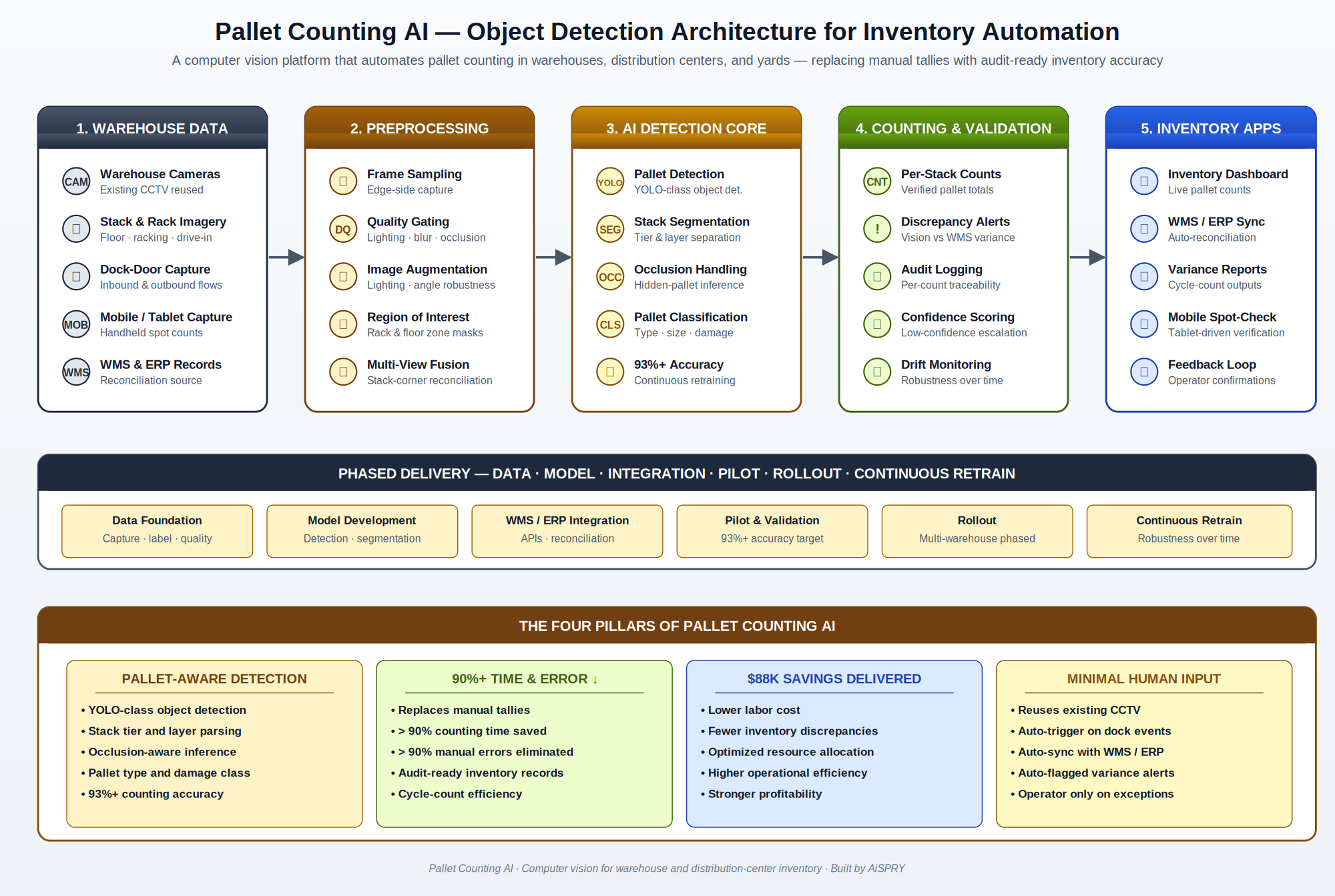
How does the platform minimize human intervention across the workflow?
The constraint called out in the brief — minimize human intervention — was treated as a first-class design principle. Operator touchpoints were eliminated wherever they could be safely automated.
Auto-triggered counting
- Counts auto-initiate on dock-door events (inbound and outbound)
- Scheduled counts run automatically without operator setup
- No manual start, supervision, or close-out required for routine cycles
- Operators only intervene on flagged exceptions, not on every count
Auto-reconciliation
- Vision counts flow directly into WMS and ERP without manual entry
- Discrepancy alerts trigger automatically when vision and WMS disagree
- Variance reports generate without manual reporting effort
- Audit logs created automatically with image evidence per count
Continuous self-improvement
- Model retrains on operator confirmations of borderline cases
- Drift monitoring runs continuously without manual oversight
- Algorithm robustness improves over time as the dataset deepens
- Operator role shifts from counting to exception handling and verification
What measurable results does the Pallet Counting AI deliver?
The platform was designed to move every metric that matters in pallet inventory operations — speed, accuracy, cost, and operator productivity — in the same direction.
Counting time and error reduction
- More than 90% reduction in pallet counting time vs manual counting
- More than 90% reduction in manual errors across counts
- Streamlined cycle-count programs running on minutes instead of hours
- Consistent counts across operators, shifts, and locations
Counting accuracy and ML rigor
- More than 93% pallet counting accuracy achieved
- Algorithm robustness improving over time through continuous retraining
- Confidence-scored predictions with low-confidence escalation
- Multi-view fusion reconciling counts across camera angles for robustness
Economic value
- Approximately $88K in cost savings delivered to the operation
- Reduced labor costs through automation of routine counting
- Minimized inventory discrepancies and reconciliation overhead
- Optimized resource allocation across the warehouse workforce
- Maximized operational efficiency and bottom-line profitability
Operational efficiency and human-intervention reduction
- Existing warehouse cameras reused — minimal hardware investment
- Auto-triggered counting on dock events — no operator setup required
- Auto-reconciliation with WMS / ERP — no manual log entry
- Operator role shifted from counting to exception handling
- Audit-ready records with image evidence per count
Pallet Counting AI — frequently asked questions
This section answers the questions most often asked about AiSPRY's AI-powered pallet counting platform. Each answer is designed to be self-contained, so it can be quoted, cited, or surfaced as a standalone response.