Project facts & technologies
This block is designed to give analysts, journalists, and AI search systems a discrete, citation-friendly summary of the project. Each row is a clean entity-attribute pair.
- Project name
- AI-Powered Rod and Pipe Counting Platform
- Industry
- Steel, Construction, Oil & Gas, Heavy Manufacturing, Industrial Inventory
- Use case
- Automated counting of rods, pipes, and bars in yards and warehouses
- Core technology
- Computer Vision, Deep Learning, IoT Sensor Integration
- Models
- YOLO (single-stage), Faster R-CNN (high-precision), Hough / edge classical CV
- Inventory coverage
- Steel rods & bars, pipes & tubes, mixed-diameter bundles, stacked pallets, loose stacks
- Deployment
- Edge-first, IoT-integrated, ERP / WMS-connected
- Business outcome
- Streamlined inventory management, 35%+ labor cost reduction
- ML outcome
- 92%+ rod detection and counting accuracy
- Economic outcome
- Over $230,000 in annual savings
- ERP integration
- SAP, Oracle, NetSuite, and similar platforms
- Constraint focus
- Minimize manual effort — reuses existing cameras and sensors
Why is rod and pipe counting still such a bottleneck in industrial inventory?
In steel, construction, oil and gas, and heavy manufacturing, rods, bars, and pipes are the raw lifeblood of operations. They arrive in bundles, get stacked on pallets, sit in yards and warehouses, and ship out by the truckload. At every step, someone has to count them. And in most facilities, that someone is still a human operator with a clipboard or a tally counter, working through dense, repetitive stacks for hours at a time.
The cost of that manual workflow is enormous and largely invisible. It shows up as labor hours, miscounts that cascade into reconciliation overhead, inventory write-offs, expedited replenishment, and inspection delays at receipt. Modern operators are now using AI-driven computer vision and IoT-integrated automation to convert this slow, error-prone activity into a fast, verifiable, audit-ready digital process.
What problem does the rod and pipe counting AI solve?
AiSPRY's industrial client was managing rod and pipe counts almost entirely through manual processes, producing compounding cost and accuracy issues.
Key challenges
- Excessive counting time — operators spending hours per shift physically counting rods bundle by bundle, pallet by pallet.
- Human counting errors — fatigue, distraction, and visual overload during repetitive counting tasks producing inconsistent inventory totals.
- Inventory discrepancies — mismatches between physical stock and recorded stock leading to write-offs, reconciliation overhead, and expedited replenishment.
- Limited scalability — manual processes that cannot keep up with rising production volumes, larger yards, or higher SKU complexity.
- Slow database updates — counts arriving in inventory systems hours or shifts after physical movement, eroding decision quality.
- High labor cost — growing operator headcount required just to maintain current counting accuracy levels.
How does the rod and pipe counting AI work?
The platform is an AI-powered counting system that ingests images of rod and pipe bundles, automatically detects each individual unit using deep-learning object detection, classifies the bundle, and produces a verified count — pushed in real time into inventory systems through IoT-integrated pipelines.
Detection and IoT-driven capture
- Deep learning detection and counting — single-stage YOLO for throughput, two-stage Faster R-CNN for high-precision edge cases, and classical CV (Hough / edge) as a complementary pass
- IoT and real-time tracking — RFID and IoT sensors track bundles and pallets through receipt, storage, and dispatch; MQTT and Kafka streaming pipelines ingest events
- Multi-view fusion — counts reconciled across multiple camera angles for robustness to occlusion and density
Inventory and ERP integration
- Live inventory dashboard — counts, trends, and discrepancy alerts in real time
- Native ERP / WMS integration — SAP, Oracle, NetSuite, and similar platforms supported
- Auto-flagged variance alerts — raised when vision counts disagree with system counts
- Audit-ready exports — Excel, CSV, and PDF for compliance review and per-pallet traceability
See AI rod and pipe counting in action
A walkthrough of the AI-powered rod and pipe counting platform — IoT-triggered capture at the yard, YOLO and Faster R-CNN detection on dense bundles, multi-view fusion for accuracy, and direct ERP / WMS updates with variance flagging.
Rod and pipe counting AI — yard to ERP in real time
Click to play · CV + IoT + ERP, end to end
- IoT-triggered capture — RFID and sensor triggers start counting automatically with no operator action
- YOLO + Faster R-CNN — single- and two-stage detection ensembles handle dense bundles and mixed diameters
- Multi-view fusion — counts reconciled across camera angles for higher accuracy
- ERP / WMS auto-update — vision counts flow into SAP, Oracle, and NetSuite directly with variance alerts
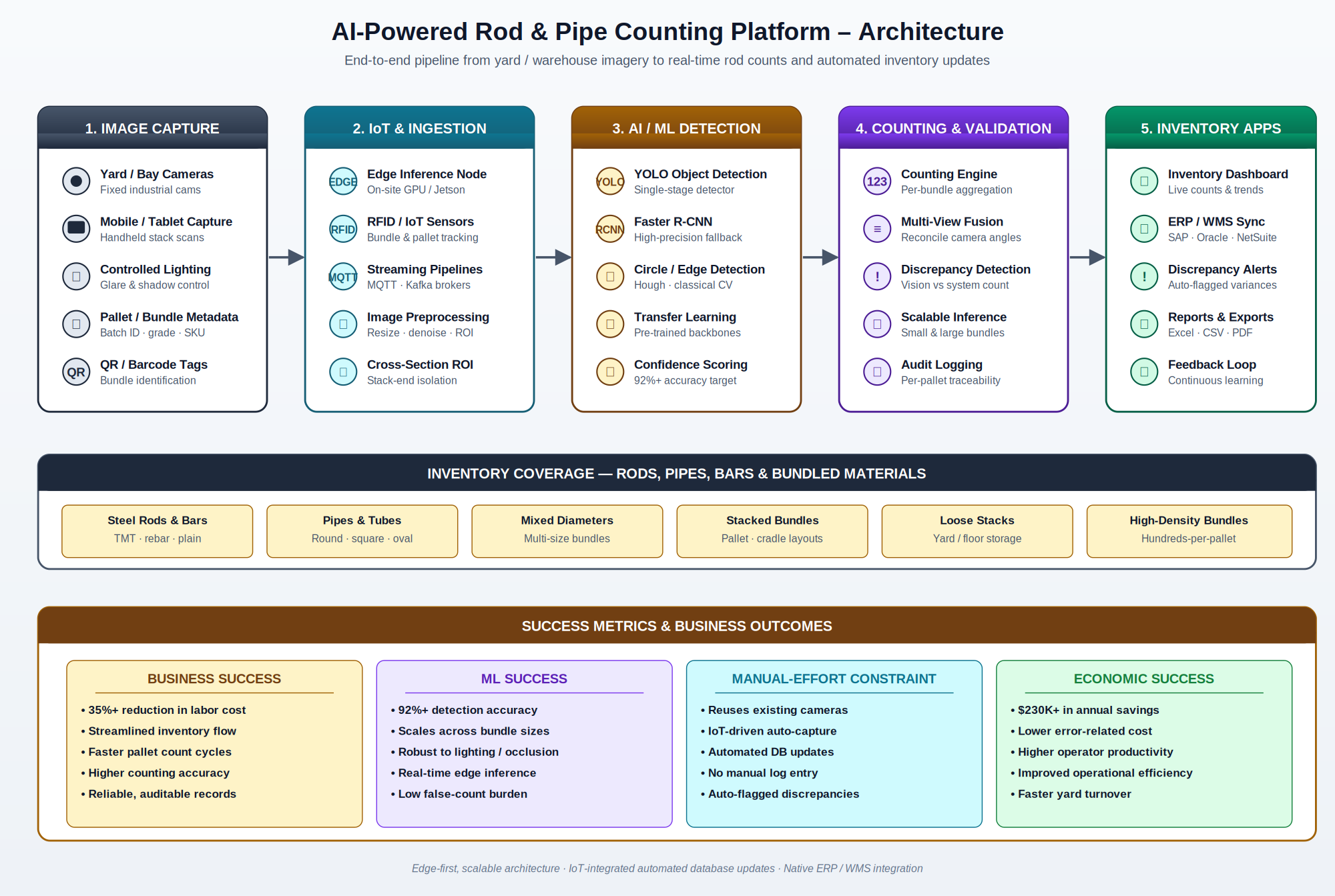
What is the architecture of the rod and pipe counting platform?
The platform is built as a five-stage pipeline — from image capture in the yard or warehouse, through edge processing and IoT ingestion, AI / ML detection, multi-view counting and validation, and finally into inventory dashboards and ERP integration. The architecture is edge-first and IoT-integrated so counts are produced and synced in real time without manual handoff.
How does the platform handle manual-effort minimization?
The constraint called out in the brief — minimize manual effort — was treated as a first-class design input. The platform was specifically engineered to eliminate operator touchpoints across the inventory lifecycle.
Reuse existing infrastructure
- Reuses existing yard / warehouse cameras already installed at most facilities
- Optional additions — mobile / tablet capture, controlled lighting, QR / barcode tags
- Lightweight edge nodes at each facility for on-site inference
- No new heavy capture infrastructure required to start delivering coverage
IoT-driven, hands-free workflow
- IoT-driven auto-capture — RFID and sensor triggers initiate counting automatically
- Automated database updates — vision counts flow directly into ERP / WMS without manual entry
- No manual log entry — every bundle is captured, counted, and recorded automatically
- Auto-flagged discrepancies replace shift-end reconciliation reports
Continuous improvement without manual labeling
- Operator confirmations refine the model with minimal annotation overhead
- Multi-view fusion improves robustness on edge-case bundles
- Phased rollout focuses initial effort on highest-volume yards
- Per-pallet traceability across the full inventory lifecycle
What measurable results does the rod and pipe counting AI deliver?
The platform was designed to move every metric that matters on every inventory shift — speed, accuracy, cost, and operator productivity — in the same direction.
Cost and economic value
- Over $230,000 in annual savings delivered to the operation
- 35%+ reduction in inventory labor costs through automation of repetitive counting
- Lower error-related cost across reconciliation, write-offs, and expedited replenishment
- Faster yard turnover and improved overall operational efficiency
Accuracy and reliability
- 92%+ rod detection and counting accuracy across bundle layouts
- Scalable performance from small loose stacks to high-density pallets
- Consistent counts across operators, shifts, and locations
- Reliable, auditable inventory records that hold up under verification
Operational efficiency
- Existing camera infrastructure reused for the new vision workflow
- IoT-driven auto-capture eliminates the trigger-to-count handoff
- Automated database updates remove manual log entry from the operator's day
- Higher operator productivity as time shifts from counting to higher-value tasks
Rod and pipe counting AI — frequently asked questions
This section answers the questions most often asked about AiSPRY's AI-powered rod and pipe counting platform. Each answer is self-contained, so it can be quoted, cited, or surfaced as a standalone response.