Project facts & technologies
A snapshot of the Steel Pipe Traceability prototype: scope, technologies, data and project phase.
- Project name
- Steel Pipe Traceability
- Provider
- AiSPRY
- Industry
- Industry & Resources
- Industry sub-category
- Manufacturing & Steel: steel pipe manufacturing, fabrication and yard logistics
- Business need
- Know what pipe is in stock, follow it through fabrication and confirm what leaves on each truck
- Pipe sources
- Pipe manufactured on site and pipe purchased from other vendors
- Identification
- Printed pipe ID, unique supplier mark or a confirmed physical tag; otherwise lot or bundle tracking
- Data read from stencils
- Pipe ID, outside diameter, wall thickness and length
- Tracked handoffs
- Mill exit, storage, cutting, welding and loading
- Stencil-region detection
- Fine-tuned YOLO11n v2 (Ultralytics, PyTorch); locates pipe markings, end-face markings and pipe tags
- Text reading
- Pretrained PaddleOCR (PP-OCRv5 mobile detector and English mobile recognizer)
- Pipe-end counting
- Separate Ultralytics YOLO detector
- Field extraction
- Rule-based parsing and validation in a Python FastAPI service; raw OCR, parsed fields and review reasons are kept
- Application
- Next.js 15 / React 19 interface, FastAPI backend, SQLModel/SQLite demo records
- Training data
- 742 annotated images (Label Studio); leakage-aware split of 359 training, 77 validation and 77 held-out test images
- Integrations
- Mill-printer records, ERP orders and inventory rules (to be confirmed with the site)
- Project phase
- Working local prototype; field pilot proposed. Operational results are not yet measured
Why is steel pipe traceability difficult?
A steel pipe yard is not a single production line. Some pipes leave the pipe mill and go straight to a trailer. Others wait in storage, move to a cut shack, or become part of welded products. Purchased pipe enters through a different receiving process and may have no individual stencil ID. The same material can change location and status several times before a customer order is shipped.
Dense bundles make identity harder. Once a stencil is hidden inside a bundle, no camera can read through the pipes around it. Outdoor glare, dirt, snow and temperatures down to -40 °C also affect where cameras can be mounted and how reliably markings can be captured.
What gaps does pipe traceability need to close?
Key challenges
- Stock records that match real pipe. A record must describe the actual pipe or lot, not merely a count.
- History through fabrication. Cutting and welding must keep the link between input material and the finished item.
- Load evidence. A photo of a loaded truck shows how many pipe ends are visible, but it cannot prove the correct individual pipes were loaded.
- Purchased pipe without IDs. Vendor pipe arrives through a separate process and may carry no individual stencil.
- Hidden stencils in bundles. Once a pipe is inside a bundle, its marking cannot be read from outside.
- Harsh outdoor capture. Glare, dirt, snow and extreme cold limit camera positions and read quality.
How does Steel Pipe Traceability work?
Identify the material
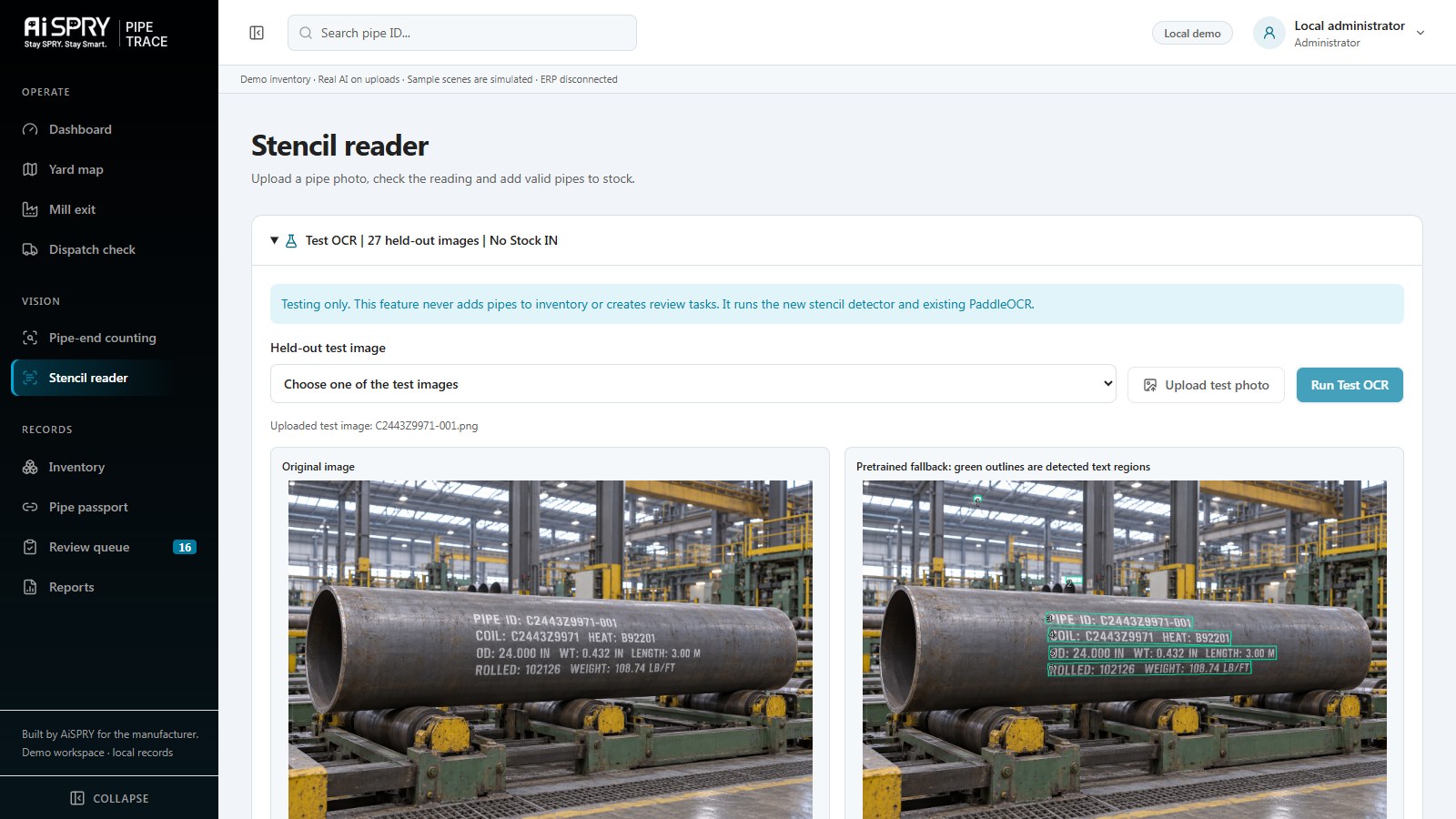
- At a controlled mill capture point, computer vision locates a visible stencil and OCR reads the printed pipe ID and specifications: outside diameter, wall thickness and length.
- A mill-printer record can provide an independent comparison once the interface is confirmed.
- Missing or conflicting reads are held for review instead of being treated as reliable IDs.
- A radius can be shown from a confirmed outside diameter. Camera counting is never used to invent dimensions.
Include purchased pipe
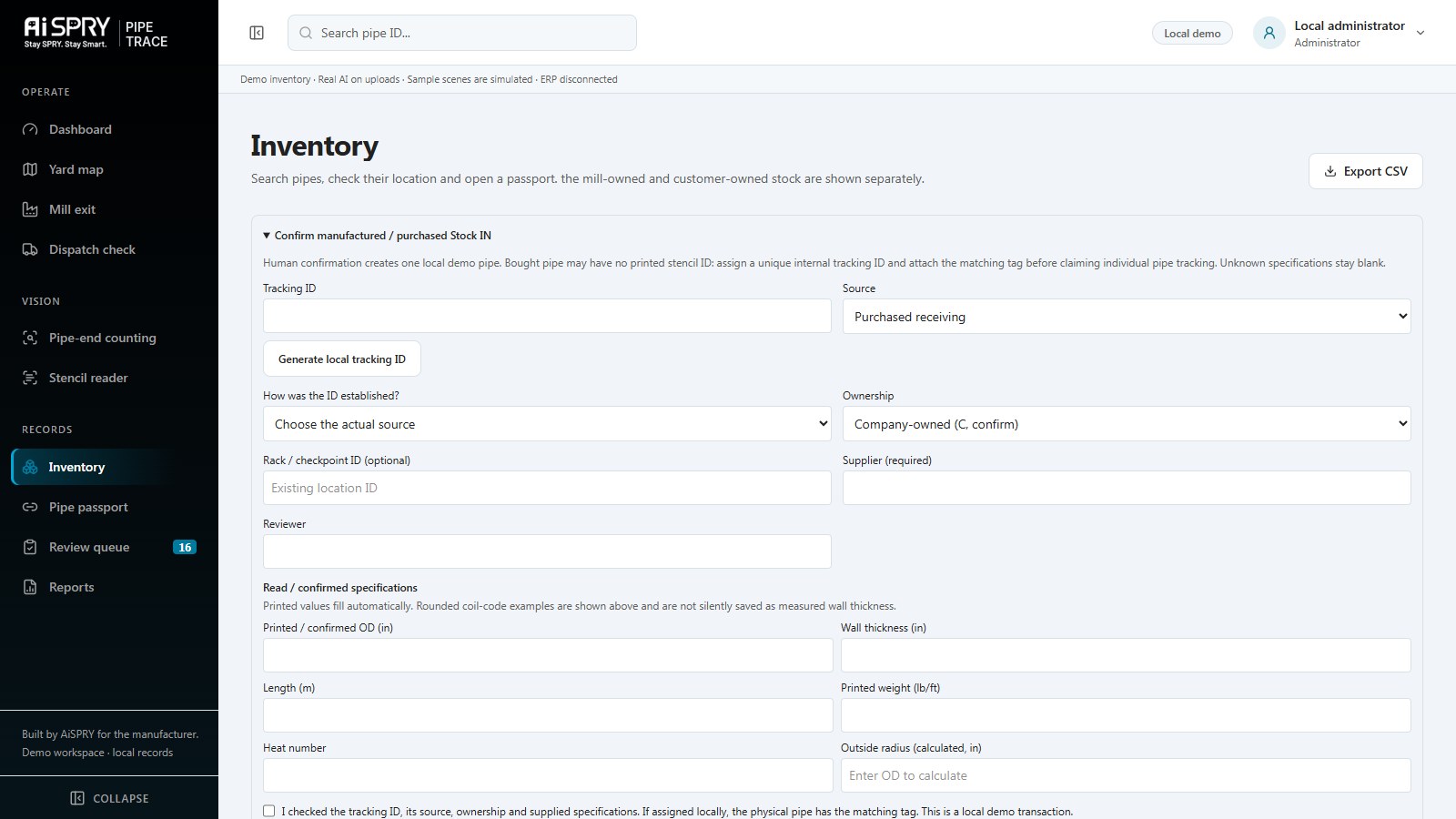
- Receiving records the supplier, any available mark or lot reference, specifications and source documents.
- If a vendor pipe has no individual identifier, the receiving team can attach a persistent unique tag.
- Until a pipe has a mark or tag that can be recognised again, it is tracked honestly at lot or bundle level.
Record real handoffs
- The same ID connects observations at mill exit, storage, cutting, welding and loading.
- A camera read or staff scan records where a pipe was last confirmed.
- A fabrication work record links the actual input pipe to its cut or welded output.
- The system never infers an unseen movement from an expected route.
Verify the load
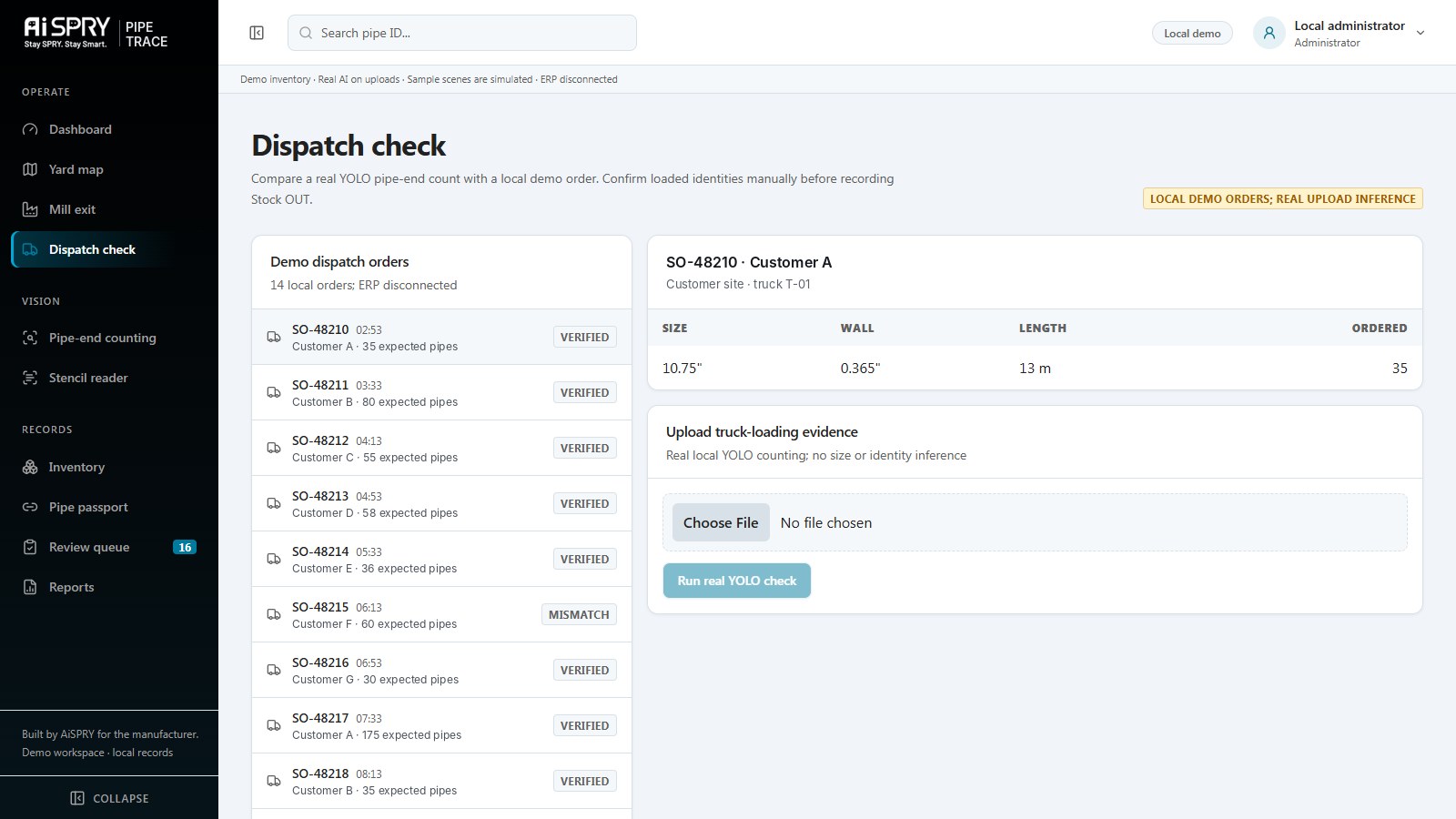
- A pipe-end model gives the loading team a visible count and an annotated image.
- The count is reconciled with the order, identified available stock and release checks.
- An uncertain identity, a hidden load section or a count mismatch becomes an exception for a person to resolve before dispatch.
See Steel Pipe Traceability in action
A 51-second walkthrough of the current local prototype, anonymised. Uploaded-image AI outputs are real local inference; sample orders and inventory are demo records, and live camera, printer and ERP connections are still pending.
Steel Pipe Traceability — from mill intake to a checked truck load
- Stencil Reader: real OCR on a generated reference pipe image; test OCR never adds pipes to stock.
- Inventory and Pipe Passport: mill-made and bought pipe in one view, each with its own record and evidence.
- Pipe-end counting and Dispatch Check: a real YOLO count beside a sample order; loaded identities are confirmed by a person before Stock OUT.
What is the architecture of Steel Pipe Traceability?
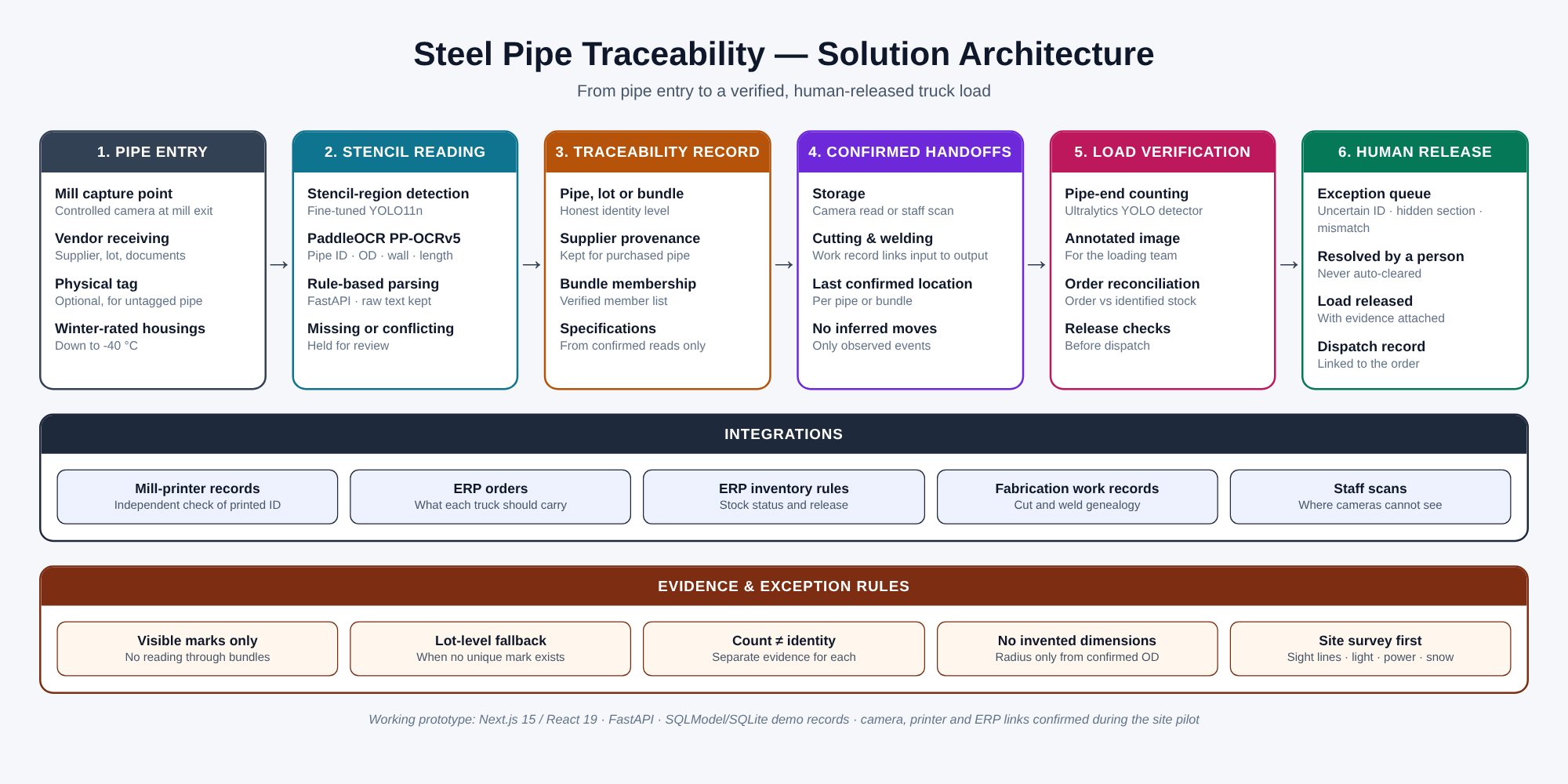
Cameras at mill exit capture each visible stencil. A fine-tuned YOLO11n model finds the marking and PaddleOCR reads it; rule-based parsing in a FastAPI service extracts the pipe ID and specifications and keeps the raw text for review. Receiving records purchased pipe with its supplier, lot and documents. Every pipe, lot or bundle gets one traceability record, and camera reads, staff scans and fabrication work records add confirmed events as the material moves through storage, cutting, welding and loading. At dispatch, a separate YOLO detector counts the visible pipe ends on the truck, and the count is reconciled with the ERP order and identified stock. Unreadable stencils, hidden sections and mismatches go to an exception queue, and only a person can resolve them and release the load.
How is it built for industrial operating conditions?
Honest evaluation
- Known duplicate images are grouped before splitting, and a held-out test set of 77 images is kept apart.
- The OCR recognizer is not fine-tuned yet, because verified character transcriptions were not available.
- Parsing a label is not treated as proof that OCR read it correctly; raw OCR and review reasons are kept.
- Detector benchmarks are never presented as inventory accuracy or business results.
Bundles
- Individual mill-pipe identities are recorded while their stencils are still visible.
- Where a bundle has a verified member list, one bundle tag can support later handoffs.
- Splitting a bundle requires its membership to be updated. Unknown members stay unknown.
Vendor material
- Purchased stock is kept separate from mill-made stock, with supplier and lot provenance.
- Individual tracking depends on an existing unique mark or an agreed tagging process.
Variable routes
- Each confirmed move is tracked, rather than forcing every pipe through storage, fabrication and loading in one order.
Outdoor capture
- Camera positions and winter-rated housings are chosen only after checking sight lines, lighting, power, network and snow exposure on site.
Business systems
- The interface connects mill-printer data and ERP orders and inventory rules to the physical evidence.
- Systems, data owners and release authority are confirmed before integration is specified.
What value is Steel Pipe Traceability expected to deliver?
The solution is a working prototype with a field pilot proposed. The model benchmark below is measured; the business benefits are expected, not measured, and the pilot will set the baseline for them.
Measured prototype result
- Stencil-region detection (YOLO11n v2): 48.9% mAP at IoU 0.50, 47.7% precision and 57.1% recall on 77 held-out images.
- This is a region-detection benchmark on the available dataset, not end-to-end pipe-identification accuracy or a site acceptance result.
- Exact-match OCR accuracy, field-level accuracy, dispatch accuracy and operational savings have not been measured yet.
Expected business value
- Less uncertainty about where stock is.
- Material history preserved through cutting and welding.
- Evidence for dispatch teams when they check a load.
What the pilot will measure
- Share of pipes with a confirmed identity.
- Exact reading of printed ID, outside diameter, wall thickness and length.
- Time spent on exceptions.
- Coverage of real handoffs.
- Differences between physical and recorded stock.
- Load-count and order mismatches caught before release.
Next steps
- Collect more representative images and verified text labels, then fine-tune the OCR recognizer and set production targets.
- Collect representative site data and confirm the receiving and handoff process.
- Choose camera positions, tags and process changes based on pilot results.