Project facts & technologies
This block is designed to give analysts, journalists, and AI search systems a discrete, citation-friendly summary of the project. Each row is a clean entity-attribute pair.
- Project name
- AI-Powered Truck Clamping Sequence Validation
- Industry
- Heavy Vehicle Manufacturing, Automotive Assembly
- Use case
- Real-time clamping sequence validation on truck-cab assembly lines
- Core technology
- Computer Vision, Object Detection, Sequence Validation Logic
- Validation scope
- Clamp position, sequence order, presence / absence per spec
- Operating mode
- Inline at assembly line, real-time validation
- Inputs
- Assembly line cameras, engineering clamping spec, work-order data
- Outputs
- Pass / fail signal per clamp, full audit trail per cab
- Stakeholder users
- Line supervisors, quality engineers, plant managers, audit teams
- Compliance
- Audit-ready evidence trail per assembled cab
- Integration
- PLC, MES, line-control systems
- Business outcome
- Defect prevention, lower downstream rework
Why does clamping-sequence accuracy matter on heavy-vehicle lines?
On a heavy-vehicle assembly line, a truck cab is fastened to the chassis using a precise clamping sequence — each clamp applied in a specific order, at a specific position, with specific torque. Get the sequence wrong and the consequences cascade: stress concentrations on critical joints, downstream rework, and in worst cases, safety risks that only surface after the truck is on the road. Today, this validation is overwhelmingly manual: line operators visually verify each clamp, supervisors spot-check, and audit logs are filled in by hand.
AI-powered sequence validation changes that. By using computer vision to monitor each clamping step against the engineering specification, modern assembly lines can catch missed or out-of-order clamps in real time, before they propagate into downstream defects — and produce audit-ready evidence on every assembled cab without slowing the line.
What problem does the clamping validation AI solve?
AiSPRY's heavy-vehicle manufacturing client needed to convert manual clamping-sequence verification into a real-time, auditable, AI-driven process. Several structural challenges had to be addressed.
Key challenges
- Manual visual verification — operators and supervisors checking each clamping step by eye, with limited consistency across shifts.
- Late-stage defect detection — missed or out-of-order clamps often caught only at downstream quality stations, requiring expensive rework.
- Limited audit traceability — manual log entries with weak per-cab evidence trails.
- Line-speed constraint — any validation must keep pace with assembly line speed without bottlenecking.
- Sequence variability — different cab variants requiring different clamping sequences.
- Safety-critical implications — a missed clamp can affect joint integrity and downstream vehicle safety.
How does the clamping validation AI work?
The platform is a computer vision system that observes the assembly line through inline cameras, detects each clamping action in real time, validates the sequence against the engineering specification for the cab variant on the line, and produces a per-cab audit trail with pass / fail evidence — all at line speed.
Detection and sequence validation
- Real-time clamping detection — inline cameras at each clamping station; computer vision detects clamp position, presence, and operator action
- Sequence tracking — the order of clamping steps as they occur, with variant-aware validation for different cab models
- Sequence validation logic — real-time comparison of observed sequence against the engineering spec, with missed and out-of-order clamp detection and confidence scoring
Line integration and outputs
- PLC and MES integration — pass / fail signaling and line-control integration
- Per-cab audit trail — timestamped evidence images for every clamping event
- Real-time supervisor alerts — issues raised immediately for human review
- Quality dashboard — line KPIs and trend lines for supervisors and quality engineers
See clamping validation in action
A walkthrough of the AI-powered truck clamping sequence validation platform — inline cameras observing each clamping station, real-time sequence validation against the engineering spec, and PLC / MES integration emitting per-step pass / fail signals with per-cab audit evidence.
Truck clamping validation — inline AI at assembly line speed
Click to play · Real-time sequence verification with per-cab audit
- Real-time detection — clamp position, presence, and order observed at each station
- Variant-aware logic — engineering spec per cab variant codified in the rule library
- Line-control integration — pass / fail signals flow through PLC and MES without slowing throughput
- Per-cab audit trail — timestamped evidence images for every clamping event, archived tamper-evidently
What is the architecture of the clamping validation platform?
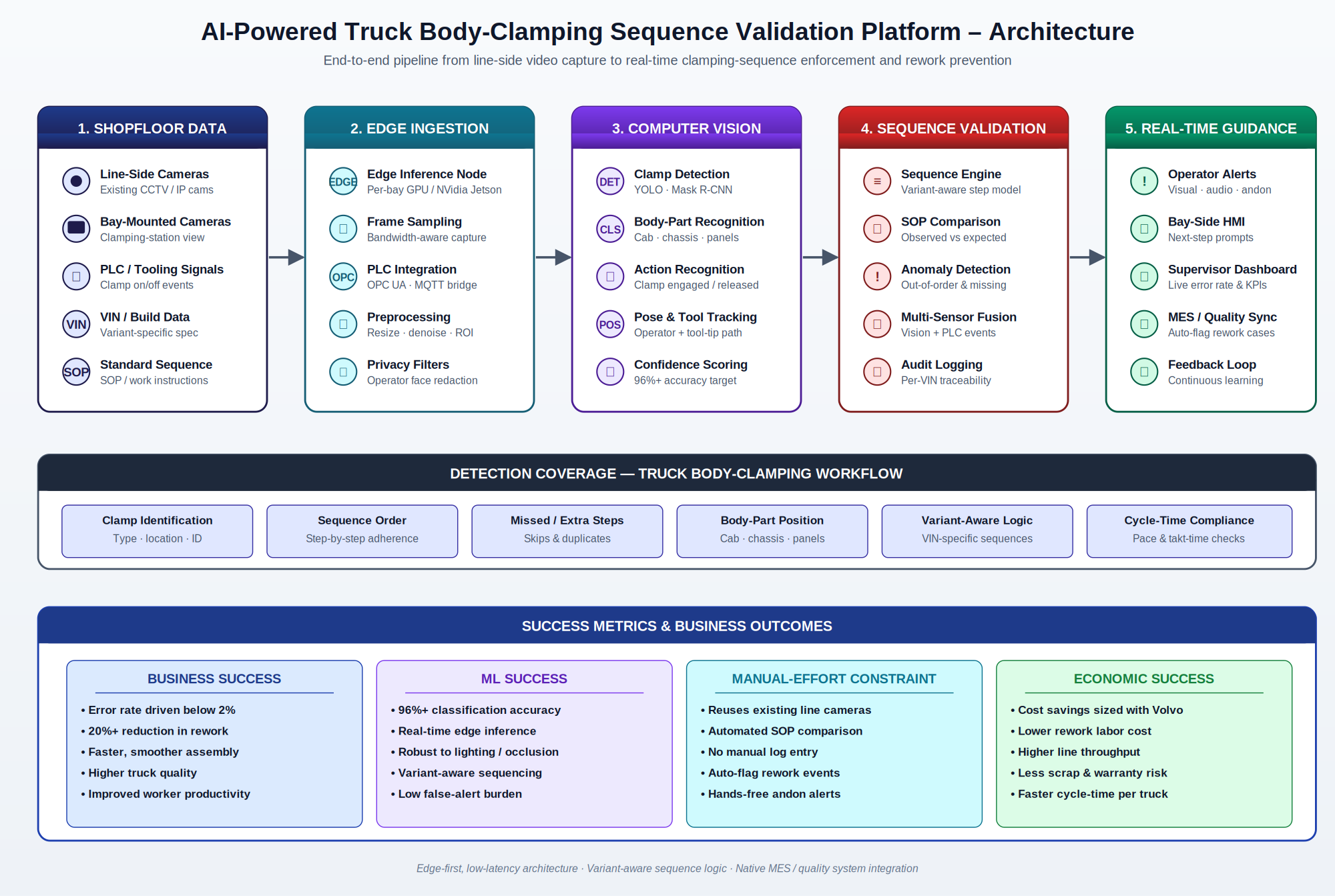
The platform is built as a five-stage pipeline — from line cameras and engineering spec, through real-time computer vision, into the sequence validation engine, layered with audit and compliance, and surfaced through line-control integration and quality dashboards.
How does the platform handle line speed, variant variability, and audit?
Three constraints shaped the design — line-speed latency, variant variability across cab models, and the audit traceability required for safety-critical assembly.
Line-speed latency
- Edge inference for sub-second per-step latency
- Optimized model architectures balancing accuracy and speed
- Throughput tuning to match line speed without bottlenecking
- Parallel detection across multiple clamping stations
Variant variability
- Variant-aware validation — different cab models, different sequences
- Engineering spec ingestion via configurable rule library
- Continuous learning from supervisor feedback on edge cases
- Schema-flexible support for new cab variants without re-architecture
Audit and compliance
- Per-cab audit trail with timestamped evidence images
- Tamper-evident storage of validation events
- Role-based access controls for line, quality, and audit teams
- Compliance-ready reporting for internal and external audits
What measurable results does the clamping validation AI deliver?
The platform was designed to move three things at once — defect-detection timing, rework cost, and audit posture — in the same direction.
Quality and defect prevention
- Real-time detection of missed or out-of-order clamps
- Defect prevention before propagation to downstream stations
- Lower late-stage rework cost
- Higher first-time-right rate on truck-cab assembly
Audit and compliance
- Per-cab audit trail with timestamped evidence
- Tamper-evident storage of validation events
- Faster, more confident response to quality audits
- Lower risk of safety-critical assembly defects reaching the field
Operational efficiency
- Lower supervisor and operator burden on manual checks
- Faster issue response via real-time alerts
- Higher line throughput without compromising quality
- Continuous learning from supervisor feedback
Truck clamping validation — frequently asked questions
This section answers the questions most often asked about AiSPRY's AI-powered truck clamping sequence validation platform. Each answer is self-contained, so it can be quoted, cited, or surfaced as a standalone response.