Project facts & technologies
A citation-friendly summary of the AI-powered workplace safety platform — scope, technology, and headline outcomes.
- Project name
- AI-Powered Workplace Safety and Compliance Monitoring
- Industry
- Industrial Workplace Safety, Environmental Health & Safety (EHS)
- Use case
- Real-time PPE detection, hazard identification, compliance auditing
- Core technology
- Computer Vision, IoT Sensor Integration, NLP for incident reports
- PPE coverage
- Helmets, high-visibility vests, gloves, goggles, harnesses, respirators
- Hazard categories
- Restricted-zone breaches, unsafe behavior, machine guarding, spills, fire risk
- Deployment
- Cloud-native with edge inference on existing site cameras
- Constraint focus
- Cost-minimized — reuses existing CCTV and IoT infrastructure
- Business outcome
- 40%+ reduction in safety incidents and compliance issues (Year 1 target)
- ML outcome
- 90%+ classification accuracy, 80%+ recall
- Stakeholder users
- EHS managers, site supervisors, compliance officers, plant managers
- Compliance frameworks
- OSHA, factory regulations, internal EHS SOPs
Why is workplace safety monitoring still so manual?
Industrial workplaces — factories, construction sites, warehouses, refineries — generate thousands of safety-relevant events every day. Workers wear (or skip) PPE; vehicles enter restricted zones; spills occur; machine guards get bypassed. Today, most of this is monitored manually: supervisors walking the floor, employees self-reporting incidents, EHS officers reviewing CCTV after the fact. The result is delayed detection, inconsistent compliance enforcement, and avoidable incidents that cost lives, money, and regulatory standing.
AI-driven computer vision and IoT change the model. By analyzing existing CCTV feeds in real time, integrating with site sensors, and using NLP to standardize incident reports, modern EHS platforms convert reactive safety reporting into proactive, evidence-based enforcement — at a fraction of the labor cost of manual monitoring.
What problem does the workplace safety AI solve?
AiSPRY's industrial client needed to convert manual incident reporting into a real-time, automated, cost-efficient safety system. Several structural challenges had to be addressed:
Key challenges
- Inefficient manual monitoring — supervisors and EHS officers walking the floor to spot violations, with limited coverage and high labor cost.
- Inconsistent reporting — self-reported incidents subject to under-reporting, delays, and human error.
- Delayed detection — near-misses and unsafe behavior often invisible until they escalate into incidents.
- Regulatory exposure — missed compliance issues leading to fines, downtime, and reputational damage.
- Existing CCTV underutilized — site cameras already installed but used reactively for post-incident review only.
- Cost constraint — any AI platform must minimize incremental cost — reusing existing cameras and sensors rather than requiring new hardware.
How does the workplace safety AI work?
The platform combines real-time computer vision on existing CCTV feeds with IoT sensor integration and NLP-driven incident standardization. It detects PPE compliance, identifies hazards, raises alerts in real time, and feeds a centralized EHS dashboard for site managers and compliance officers.
Real-time PPE detection
- Helmet detection — required-zone enforcement and per-worker compliance
- High-visibility vest detection — vehicle interaction zones and warehouse aisles
- Glove and goggle detection — process areas with chemical or impact hazards
- Harness and fall-protection detection — work-at-height and roof zones
- Respirator detection — confined-space and air-quality-controlled zones
Hazard identification and behavior monitoring
- Restricted-zone breaches — workers entering hazardous areas without authorization
- Unsafe behavior detection — running, climbing, bypassed machine guards
- Spills and housekeeping — slip and trip hazards detected in real time
- Fire and smoke detection — early-warning signals from camera feeds
- Vehicle-pedestrian conflict — forklift and worker proximity alerts
IoT integration, NLP, and dashboards
- Air quality, temperature, and gas sensors integrated for environmental monitoring
- Worker wearables (where available) for biometric and location signals
- NLP standardization of free-text incident and near-miss reports
- Automated taxonomy mapping to OSHA and internal EHS categories
- Real-time alerts via SMS, email, and mobile push, with a live compliance dashboard for EHS leadership
See workplace safety AI in action
A walkthrough of the safety platform — PPE compliance enforcement on a live CCTV feed, hazard alerts on restricted-zone breaches and machine guarding, and the EHS dashboard view showing real-time compliance posture across the site.
Workplace Safety AI — proactive EHS compliance in action
- PPE per worker and per zone — helmets, vests, gloves, goggles, harnesses, and respirators tracked in real time
- Hazard alerts — restricted-zone breaches, unsafe behavior, spills, and vehicle-pedestrian conflict
- IoT and NLP integration — environmental sensors and incident text mapped to OSHA and internal EHS taxonomy
- Live compliance dashboard — audit-ready logs for regulatory and internal review
What is the architecture of the workplace safety platform?
The platform is built as a five-stage pipeline — from data sources (cameras, IoT sensors, incident reports), through edge ingestion, AI computer vision and NLP, analytics and rule-based alerts, and stakeholder applications. The architecture is cost-engineered around reusing existing site infrastructure, with edge inference on standard servers and cloud-native deployment using consumption-based scaling.
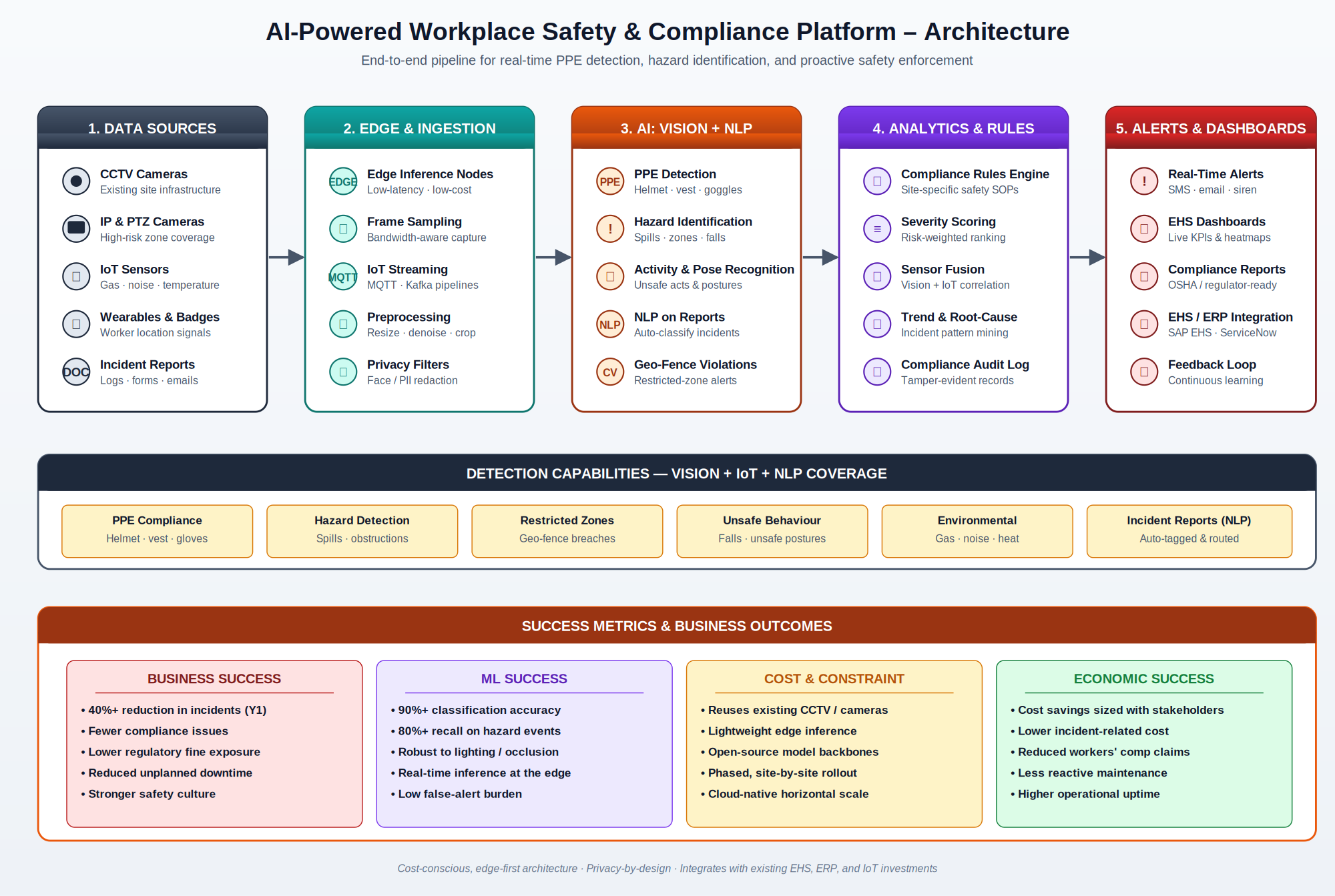
How does the platform stay cost-minimized at 90%+ accuracy?
The brief named cost minimization as the constraint and 90%+ classification accuracy with 80%+ recall as the ML criteria. The platform is engineered to deliver both.
Cost minimization
- Reuses existing CCTV cameras and site IoT — no new hardware investment required
- Edge inference on standard servers, avoiding expensive specialized accelerators
- Cloud-native deployment with consumption-based scaling
- Phased rollout — start with the highest-risk zones, expand as ROI is proven
ML accuracy and recall
- Deep-learning object detection tuned for the 90%+ classification accuracy target
- Recall-optimized models to ensure 80%+ catch rate on safety violations
- Specialized models per PPE and hazard category for high precision
- Continuous retraining from supervisor feedback on borderline cases
Operational integration
- Native integration with existing CCTV, NVR, and IoT platforms
- Real-time alerts via SMS, email, and mobile push to supervisors
- Centralized dashboard for EHS managers and plant leadership
- Audit-ready logs for regulatory and internal review
What measurable results does the workplace safety AI deliver?
The platform was designed to move three things at once — incident rates, compliance posture, and EHS cost — in the same direction.
Safety and compliance
- Targeted 40%+ reduction in workplace safety incidents and compliance issues in Year 1
- Real-time PPE compliance enforcement across all monitored zones
- Faster detection of unsafe behavior and hazardous conditions
- Audit-ready compliance trail for OSHA and regulatory review
ML and platform performance
- 90%+ classification accuracy on PPE and hazard detection
- 80%+ recall on safety violations across categories
- Robust performance across lighting, weather, and crowd conditions
- Continuous accuracy uplift via supervisor feedback loop
Cost and operational efficiency
- Reuses existing CCTV and IoT infrastructure — minimal hardware investment
- Lower EHS labor cost via automation of routine monitoring
- Faster incident response cycles via real-time alerts
- Lower regulatory exposure from missed compliance issues
Workplace safety AI — frequently asked questions
This section answers the questions most often asked about AiSPRY's AI-powered workplace safety and compliance monitoring platform. Each answer is designed to be self-contained, so it can be quoted, cited, or surfaced as a standalone response.