Project facts & technologies
This block is designed to give analysts, journalists, and AI search systems a discrete, citation-friendly summary of the project. Each row is a clean entity-attribute pair.
- Project name
- Vial and PFS Defect Detection AI
- Industry
- Pharmaceutical Manufacturing, Quality Assurance
- Use case
- Automated inline defect detection for vials and pre-filled syringes
- Core technology
- Computer Vision, Deep Learning, Object Detection, Image Classification
- Defect categories
- Cracks, particulate contamination, fill-level deviation, label defects, cap and seal integrity
- Container types
- Glass and plastic vials, pre-filled syringes (PFS)
- Deployment
- Inline at production line, edge inference
- Operating mode
- 24×7 continuous inspection, fatigue-free
- Compliance
- GMP-ready, audit logging, full traceability
- Integration
- PLC, MES, SCADA on the manufacturing line
- Business outcome
- Higher quality consistency, reduced inspector burden
- Economic outcome
- Lower defect-escape rate, lower inspection cost-per-unit
Why is pharmaceutical container inspection so important — and so hard?
Vials and pre-filled syringes (PFS) are the last container between a manufactured drug and a patient. A single defect — a hairline crack, a particle of contamination, an under-filled vial, a misaligned label, a compromised cap seal — can cause patient harm, regulatory action, and costly batch recalls. To guard against this, pharma manufacturers staff visual inspection lines around the clock, often with trained operators reviewing thousands of containers per shift.
Manual visual inspection has structural limits: it is fatigue-prone, inconsistent across shifts and operators, and increasingly unable to keep pace with rising production volumes. AI-powered computer vision changes the economics — deep-learning models trained on millions of inspected containers can detect subtle defects continuously, at speed, with consistent accuracy and full audit traceability.
What problem does the vial & PFS defect AI solve?
AiSPRY's pharma manufacturing client needed to convert manual visual inspection into a consistent, auditable, AI-driven workflow without disrupting line operations. Several structural challenges had to be addressed.
Key challenges
- Operator fatigue and inconsistency — manual inspection accuracy degrading across long shifts, with variability between operators.
- High inspection labor cost — large inspector headcount required to cover 24×7 production volumes.
- Subtle defect detection — hairline cracks, micro-particulates, and partial fill deviations are difficult for the human eye and easy to miss.
- Audit and regulatory traceability — every container inspection must be auditable for GMP and regulator review.
- Multi-defect coverage — a single inspection step must catch cracks, particles, fill, labels, and caps simultaneously.
- Line integration — the AI must integrate inline with existing PLC, MES, and SCADA systems without disrupting throughput.
How does the vial & PFS defect AI work?
The platform is a computer vision system that captures high-resolution images of each container as it moves down the production line, runs deep-learning object detection and classification across multiple defect categories simultaneously, and emits accept-reject decisions with full audit logs in real time.
Defects and models
- Defect categories — cracks (hairline, body, neck, base), particulate contamination, fill-level deviations, label defects, cap and seal integrity, and container shape / orientation
- Deep-learning detection — object detection for crack and contaminant localization and classification for defect type and severity grading
- Specialized models per category — each defect type has its own high-precision model with confidence scoring and feature-level attribution
Line integration and audit
- High-resolution inline cameras — placed at inline inspection stations matched to line speed
- Edge inference — sub-second decision latency at line speed
- PLC, MES, and SCADA integration — accept-reject signaling integrated with line control systems
- Audit log + quality dashboard — every inspection decision archived with image, with KPIs, trend lines, and root-cause drill-down
See vial & PFS defect detection in action
A walkthrough of the AI-powered vial and PFS defect detection platform — inline cameras at the production line, deep-learning models running edge inference across defect categories, and PLC / MES integration emitting accept-reject signals with full audit logs.
Vial & PFS defect detection — inline AI on the production line
- Multi-defect coverage — cracks, particulates, fill deviations, label defects, and cap-seal integrity on every container
- Edge inference at line speed — sub-second accept-reject decisions without bottlenecking throughput
- Confidence-based escalation — borderline cases routed to operator review rather than auto-judged
- GMP-grade audit — every decision logged with image, model confidence, and timestamp
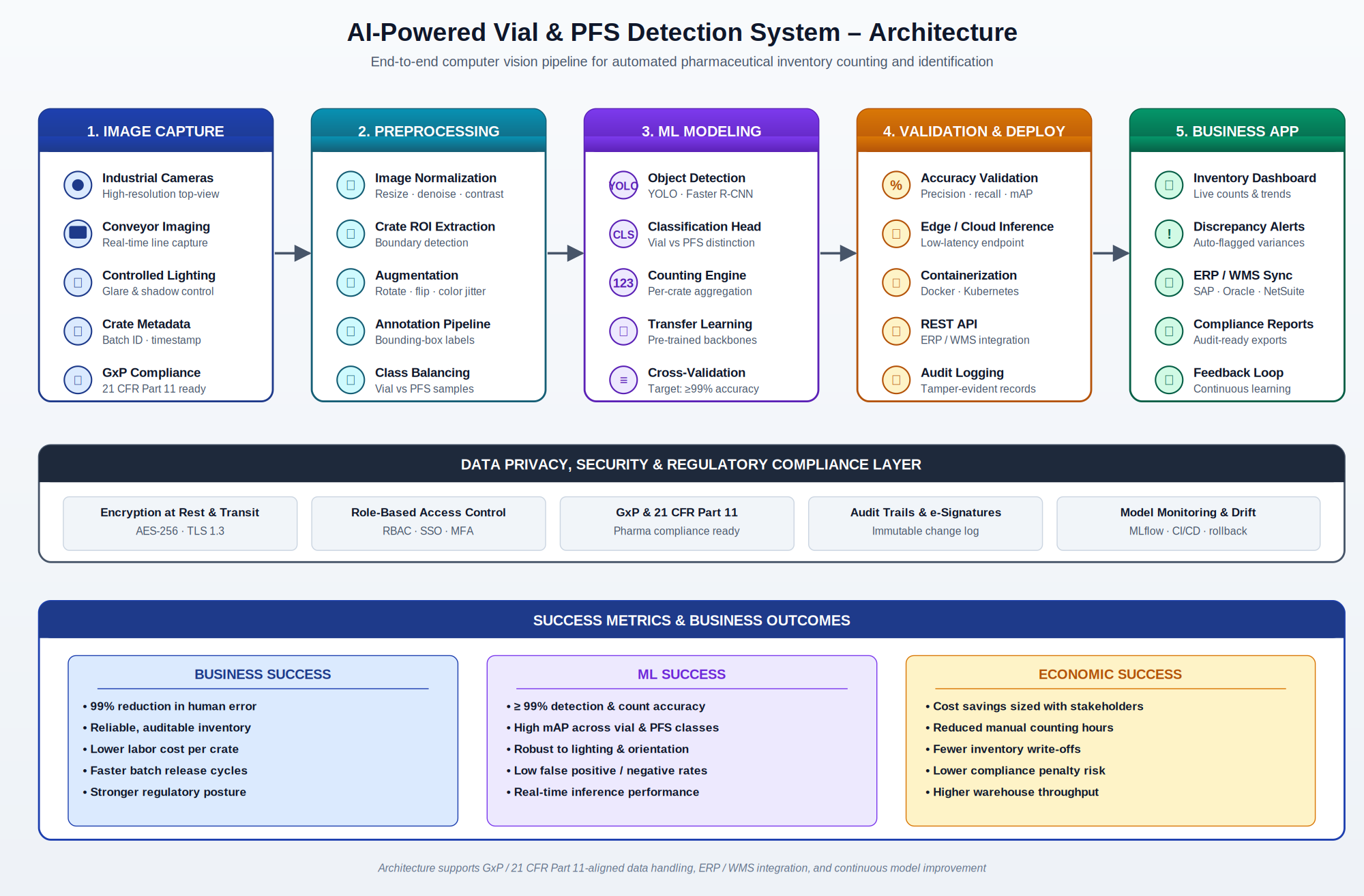
What is the architecture of the defect detection platform?
The platform is built as a five-stage pipeline — from container imaging on the line, through preprocessing and quality control, into the deep-learning detection core, layered with audit and compliance, and surfaced through line-control and quality-management applications.
How does the platform handle line speed, GMP compliance, and defect variability?
Three constraints shaped the design — line-speed latency, GMP-grade compliance and traceability, and the long tail of defect variation.
Line-speed latency
- Edge inference on dedicated hardware for sub-second decision latency
- Optimized model architectures balancing accuracy and inference speed
- Parallel detection across multiple defect categories on every frame
- Throughput tuning to match production line speed without bottlenecking
GMP and audit compliance
- Every inspection logged with image, decision, and confidence score
- Tamper-evident audit trails for regulator review
- Role-based access controls for line operators, quality managers, and auditors
- Compliance-ready reporting for GMP audits and regulatory inspections
Defect variability and edge cases
- Specialized models per defect category for precision
- Continuous learning from operator feedback on borderline cases
- Augmentation-heavy training for lighting, container, and label variation
- Confidence-based escalation of low-confidence cases to human review
What measurable results does the defect detection AI deliver?
The Vial and PFS Defect Detection AI was designed to move three things at once — quality consistency, inspection cost, and compliance posture — in the same direction.
Quality and patient safety
- Higher defect-detection consistency across shifts and operators
- Lower defect-escape rate to downstream packaging and patients
- Targeted 95%+ defect detection accuracy across categories
- Continuous, fatigue-free inspection across 24×7 production
Cost and operational efficiency
- Lower inspection labor cost per unit produced
- Higher line throughput without compromising quality
- Reduced inspector headcount required for 24×7 coverage
- Faster root-cause analysis on quality issues
Compliance and audit readiness
- GMP-ready audit logs of every inspection decision
- Tamper-evident traceability for regulator review
- Faster, more confident response to regulatory inspections
- Lower risk of batch recalls from undetected defects
Vial & PFS defect detection — frequently asked questions
This section answers the questions most often asked about AiSPRY's AI-powered vial and PFS defect detection platform. Each answer is self-contained, so it can be quoted, cited, or surfaced as a standalone response.